a playground of art, photos, videos, writing, music, life
You are here
Creativity!
Get it!
I like it!
Fun stuff!
About me...
Random Quote
When I went to school, I knew poetry was not a dead thing. I knew it was always written by the living, even though the dateline said the man was dead. -- Stephen Vincent Benet
A few days ago, I postulated that McCain will likely be the nominee for the Republicans. And I said that I would feel better about voting for him than letting Hillary into office.
After watching McCain the past few days, I spoke too soon. McCain's insistence that he would sign his immigration legislation into law, his employ of Juan "Mexico First" Hernandez, and his outright lie about Romney show me again that there is no way I can vote for the guy. I'd rather see the Democrats show us how not to lead the country, as Pelosi and Reid have amply demonstrated, than have the blame shifted to a Republican.
Our American president has to have an attitude of "America First," not Mexico first, as McCain-Kennedy would do. And while I completely expect politicians to juxtapose their own positions to that of their opponents, lying about an opponent's record is not "straight talk." It's misrepresentation, and coming from the guy who co-authored McCain-Feingold to "clean up" campaign speech, McCain is too obnoxious in his piety to earn my vote.
One of my favorite features of the system I've been developing is the comparison chart that spawns dynamically from the search results. I've opened that page because I'm up late testing, re-writing the recruiter's user manual for the latest usability changes, and making "public" a few of the approved candidates on the beta site. As I'm doing this, I hopped into the comparison chart.
Know of another search engine that allows you to create a comparison chart like this? I'm hoping that features like this one will set this tool apart from other options.
The suggestion for it came from John, Paragon's ace marketing guy. I'm a very big believer that development should take place right next to the end users so that the right tools can be written. I don't care how genius a person might be, they can't in any way imagine every scenario in a user's day.
I heard a guy once say in a meeting with about 70 other people that developers don't need to know how a user does their job - that's what business analysts are for, he insisted. A brawl damn near broke out over that remark as I heartily disagreed with him. The more layers between the developer and the end-user, the less the application will fit the needs of business and the more it can't help but create frustration for the end-user.
Can't listen well if you're not near your customer, ya know?
Just a thought for those who despise corporations...
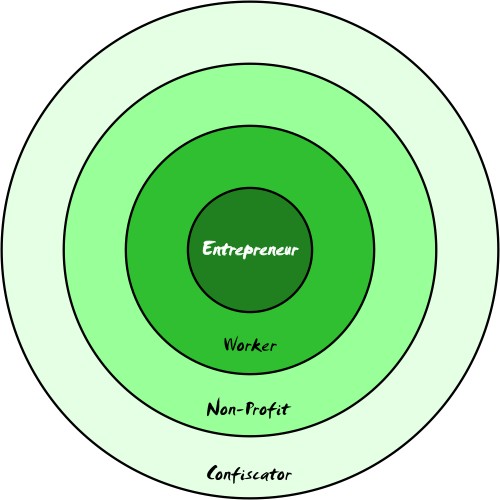
There are four ways to make money:
Work for yourself.
Work for someone else.
Ask for voluntary donations.
Force someone else to give you the money involuntarily.
And here's an example of each:
Entrepreneurs
Just about every American worker
Non-profits
John Edwards
It seems to me that if anti-corporate types loathe the corporation so much, shouldn't they be strident entrepreneurs? That's the only true escape from "corporations," because if you work for yourself, you can choose to be a sole-proprietor. No corporation necessary.
On the other hand, workers work at corporations.
Non-profits rely on the money generated at corporations for donations by either business owners, businesses, or the employees of businesses.
And the blood sucker who parades around shouting down corporations, while trying to extract money from them? He relies supremely on confiscation from corporations in order to attain any wealth. How does the role of anti-corporate crusader deserve any dignity whatsoever? "Hypocrite" is a more likely and worthy title.
It all begins with the entrepreneur.
The confiscators - played by anti-corporate lawyers and the government, for example - don't do anything to create value in society. Why anyone champions confiscators is beyond my comprehension.
Ever wondered how many political parties there are in the good ol' US of A? Yes, effectively "Two" is the right answer, but check this out... here's a list, copied and trimmed from this site:
America First Party: The AFP vows to "protect our people and our sovereignty... promote economic growth and independence... encourage the traditional values of faith, family, and responsibility... ensure equality before the law in protecting those rights granted by the Creator... [and] to clean up our corrupted political system." The party failed to nominate any candidates in 2004, and has been almost totally inactive since then. One AFP faction, based in Iowa, vowed in 2006 to start rebuild the party.
American Independent Party: Governor George C. Wallace (D-AL) founded the AIP and ran as the its first Presidential nominee in 1968. Running on a fiery populist, right-wing, anti-Washington, anti-racial integration, anti-communist platform, Wallace carried nearly 10 million votes (14%) and won 5 Southern states. The AIP still fields local candidates in a few states - mainly California - but is now merely a state affiliate party of the national Constitution Party. For the past several presidential elections, the AIP simply co-nominated the Constitution Party's Presidential nominee.
American Nazi Party: Exactly what the name implies... these are a bunch of uniformed, swastika-wearing Nazis! This miniscule party - while purportedly denouncing violence and illegal acts - blends left-wing economic socialism, right-wing social fascism, and strong totalitarian sentiments.
American Party: The AP is a very small, very conservative, Christian splinter party formed after a break from the American Independent Party in 1972. Beyond the pro-life, pro-gun and anti-tax views that you'd expect to find, the American Party also advocates an end to farm price supports/subsidies, privatization of the US Postal Service, opposes federal involvement in education, supports abolition of the Environmental Protection Agency, supports repeal of NAFTA, opposes minimum wage laws, opposes land use zoning regulations and opposes convening a Constitutional convention. Of course, the AP also opposes the United Nations, the New World Order, communism, socialism and the Trilateral Commission.
American Patriot Party: The The APP, established in 2003, was "founded on the basic principals set forth by our founding fathers, that the federal government should only have the powers set forth in the framework of the Constitution and all other power to be delegated back to the states. Although everyone has thier own opinions on all issues, we believe it is up to the states to decide what should and should not be mandated, banned or regulated." The APP supports a crackdown on illegal immigration, making English fluency a requirement of US citizenship, abolishing the IRS and repealing the federal income tax, imposing steeper taxes and tariffs on imported goods, abolition of the centralized Federal Reserve System, withdrawing the US from the Untied Nations, imposing a foreign policy of non-interventionism, and ending federal involvement in education.
American Reform Party: The ARP, formerly known as the National Reform Party Committee, splintered away from Ross Perot's Reform Party in 1997. The ARP chafed at Perot's heavy-handed desire to maintain total control over the RP. In 1998, the ARP fielded some candidates for state and federal offices in "Reform Party" primaries against candidates backed by Perot's Reform Party with mixed results. The ARP soon shifted left and opted to "endorse" (but not co-nominate) Green Party Presidential nominee Ralph Nader in the 2000 elections.
American Socialist Party: Despite the word "Socialist" in their title, this new group, founded in 2004 and based in Arizona, is far out of the traditional definition of socialist parties. The ASP denounces "immorality, and materialism," supports "the removal of illegal immigrants... [and the imprisonment of] businesses/officials who hire, or allow them to enter," sees capitalism as "failing," and - in a language that make them sound more like a crypto-fascist group - promises to "defend you and your family if faced with government officials intimidating you, or, violating your rights, with the same force."
Christian Falangist Party Of America: A "Falangist" is a follower of the authoritarian political views advocated by the late Spanish dictator Francisco Franco (to wit: largely a blend of 1930s fascist ideology, strong nationalism and conservative Catholic theology).
Communist Party Usa: The CPUSA, once the slavish propaganda tool and spy network for the Soviet Central Committee, has experienced a forced transformation in recent years. Highly classified Soviet Politburo records, made public after the fall of Soviet communism in the 1990s, revealed the Communist Party of the Soviet Union (CPSU) illegally funneled millions of dollars to the CPUSA to finance its activities from the 1920s to the 1980s. The flow of Soviet dollars to the CPUSA came to an abrupt halt when the Soviet communists were ousted from power in 1991 - ultimately causing a retooling of CPUSA activities. As for issues, the CPUSA calls for free universal health care, elimination of the federal income tax on people earning under $60,000 a year, free college education, drastic cuts in military spending, "massive" public works programs, the outlawing of "scabs and union busting," abolition of corporate monopolies, public ownership of energy and basic industries, huge tax hikes for corporations and the wealthy, and various other programs designed to "beat the power of the capitalist class... [and promote] anti-imperialist freedom struggles around the world."
Constitution Party: Former Nixon Administration official and one-time Conservative Coalition chair Howard Phillips founded the US Taxpayers Party (USTP) in 1992 as a potential vehicle for Pat Buchanan to use for a third party White House run - had he agreed to bolt from the GOP in 1992 or 1996. The USTP pulled together several of the splintered right-wing third parties - including the once mighty American Independent Party - into a larger, more visible political entity. Renamed as the Constitution Party in 1999, the party is strongly pro-life, anti-gun control, anti-tax, anti-immigration, protectionist, "anti-New World Order," anti-United Nations, anti-gay rights, anti-welfare, pro-school prayer... basically a hardcore Religious Right platform.
Constitutionalist Party: This quasi-libertarian new party "seeks to improve America and preserve the freedom of the people by supporting a closer adherence to the Constitution." As for specific issues, the CP is pro-choice (but believes abortion issues need to be decided at the state level), pro-gun rights, anti-death penalty, anti-Affirmative Action quotas, anti-regulation of sexual activities between consenting adults, pro-medical marijuana, pro-flat tax, pro-tax cuts, and anti-United Nations.
Democratic Socialists Of America: The DSA is the official US full member party of the Socialist International (which includes UK's Labour Party, the French Parti Socialiste and nearly 140 other political parties around the globe). The DSA explains their mission as follows: "building progressive movements for social change while establishing an openly socialist presence in American communities and politics." Thus, the DSA is less like a traditional US political party and much more like a political education and grassroots activism organization.
Family Values Party: This ultra-conservative, theocratic party seems to exist mainly to promote the frequent federal candidacies of party founder Tom Wells of Florida. Wells explained that God spoke directly to him on December 25, 1994 at 2:00 a.m. and "commanded him to start" the FVP. To be exact, Wells said God specifically told him to encourage people to stop paying taxes until the public funding of abortion ends. The FVP political platform is largely derived from religious fundamentalism, including many specific citations to Bible passages. This "party" remains largely an alter-ego of Wells - who seems to run every election as a write-in candidate for President or Congress (or both).
Freedom Socialist Party / Radical Women: The FSP was formed in 1966 by a splinter group of dissident feminist Trotskyites who broke away from the Socialist Workers Party to create a new party in the "tradition of Marx, Engels, Lenin and Trotsky." That's the reason they also refer to their entity as "Radical Women." The FSP describe themselves as a "revolutionary, socialist feminist organization, dedicated to the replacement of capitalist rule by a genuine workers' democracy that will guarantee full economic, social, political, and legal equality to women, people of color, gays, and all who are exploited, oppressed, and repelled by the profit system and its offshoot - imperialism."
Green Party Of The United States (Green Party): The Green Party - the informal US-affiliate of the leftist, environmentalist European Greens movement - is one of the two largest third parties in the nation. The party regularly fields candidates for local, state and federal offices in many states, and has established active state affiliate parties in nearly all 50 states. The Greens scored a major political points when it convinced prominent consumer advocate Ralph Nader to run as their first Presidential nominee in 1996. Spending just over $5,000, Nader was on the ballot in 22 states and carried over 700,000 votes (4th place: 0.8%). In 2000, Nader raised millions of dollars, mobilized leftist activists and grabbed national headlines with his anti-corporate campaign message.
Independence Party: After two years of openly feuding with Ross Perot's allies in the Reform Party, Minnesota Governor Jesse Ventura and his supporters bolted from the party to launch the new Independence Party in 2000. While this splinter party shared the Reform Party's call for campaign finance and other political reforms, the IP shared Ventura disagreement with the more social conservative and trade protectionist views espoused by the Reform Party. The IP - which describes itself as "Socially Inclusive and Fiscally Responsible" - is pro-choice, pro-gay rights, pro-medical marijuana, pro-gun rights and fiscally moderate.
Independent American Party: The small Independent American Party has existed for years in several Western states - a remnant from the late Alabama Governor George Wallace's once-powerful American Independent Party of the 1968-72 era. Converting the unaffiliated IAP state party organizations - united by a common Religious Right ideology (similar to the Constitution Party) - into a national IAP organization was an effort started in 1998 by members of Utah IAP.
Labor Party: The Labor Party is a liberal entity created in 1996 by a sizable group of labor unions including the United Mine Workers, the Longshoremen, American Federation of Government Employees, California Nurses Association and other labor union locals. The party explains it was formed because "on issues most important to working people - trade, health care, and the rights to organize, bargain and strike - both the Democrats and Republicans have failed working people."
Libertarian National Socialist Green Party: This party purports to be comprised of atheist, peaceful, pro-gay, pro-drug legalization, anti-racist, environmentalist Nazis who acknowledge the Holocaust likely occurred (but are neutral as to its justification) and oppose the government sponsored killing of Jews, Christians & gays and the disabled.
Libertarian Party: The LP, founded in 1971, bills itself as "America's largest third party" (and, along with the Greens, are definitely among the two largest third parties in the nation). The Libertarians are neither left nor right: they believe in total individual liberty (pro-drug legalization, pro-choice, pro-gay marriage, pro-home schooling, anti-gun control, etc.) and total economic freedom (anti-welfare, anti-government regulation of business, anti-minimum wage, anti-income tax, pro-free trade, etc.). The LP espouses a classical laissez faire ideology which, they argue, means "more freedom, less government and lower taxes."
Light Party: This San Francisco-based party's platform promotes holistic medicine, national health insurance, organic foods, solar energy, nuclear disarmament and a flat tax.
Moderate Party: The party platform covers only a few main points: ending the Iraq War and returning the US "to its primary role as international peacekeeper," cut federal spending, abandon the current tax code in favor of a flat tax or consumption tax plan, protect the envinromnent, strengthen the separation of church and state, protect second amendment gun ownership rights, protect a women's right to choose on abortion, and support for same-sex civil unions.
Multicapitalist Party: This quirky party supports "capitalism for all people equally" - but it is hard to tell exactly what that means. The MP claims to be an economic ideology whereby "the government insures that every citizen will become a successful capitalist and land owner without excessive taxation or loss of privacy or freedom."
National Socialist Movement: "We co-operate and work with many like minded white nationalist groups such as the KKK (Ku Klux Klan), Aryan Skinheads, the Racial Nationalist Party of America and many others which are either neo Nazi or at least, racially aware of our Aryan Heritage," explains the NSM website.
Natural Law Party: The Natural Law Party was a New Age entity founded and run by followers of Maharishi Mahesh Yogi (the founder of the TM movement - a movement that some have labeled as a cult). The NLP - under the slogan "Bringing the light of science into politics" and using colorful imagery - advocated holistic approaches, Transcendental Meditation (TM), "yogic flying," and other peaceful "New Age" and "scientific" remedies for much of our national and international problems.
New Party: This leftist party advocates a "democratic revolution" to advance the cause of "social, economic, & political progress" in America. Their agenda is much in the style of the Western European socialist and labor movement - and somewhat similar to that of the late-1990s formed Labor Party (but the NP has more of a controlled growth outlook on environmental issues).
New Union Party: Founded in 1980 by defectors from the Socialist Labor Party, this DeLeonist militant democratic socialist party "advocates political and social revolution" but denounces violence and is "committed to lawful activities to overthrow the capitalist economic system."
Pansexual Peace Party: The PPP is a generally left-wing party that has yet to field any candidates - they don't take themselves too seriously - and, oh yeah, and the PPP is founded on Wiccan (i.e., witchcraft) roots.
Party Of Socialism And Liberation: The Party of Socialism & Liberation (PSL) is a revolutionary Marxist party created "to be a vehicle for the multinational working class in the struggle for socialism... Only a multinational party can create the unity necessary to defeat the most powerful capitalist class the world has ever seen... We aim for revolution in the United States."
Peace And Freedom Party: Founded in the 1960s as a left-wing party opposed to the Vietnam War, the party reached its peak of support in 1968 when it nominated Black Panther leader Eldridge Cleaver for President.
Pot Party: ThePot Party is exactly what you'd expect - a bunch of marijuana legalization advocates.
Progressive Labor Party: The PLP is a New York-based, militant, Stalinist-style communist party dedicated to bringing about a world-wide, armed, communist revolution.
Prohibition Party: "If you are a reform-minded conservative and a non-drinker, the Prohibition Party wants you," exclaimed an official party message in 2002. The Prohibition Party - founded in 1869 and billing themselves as "America's Oldest Third Party" - espouses a generally ultra-conservative Christian social agenda mixed with anti-drug and international anti-communist views.
Reform Party: Once a rapidly growing, populist third party, the Reform Party shifted far to the right in recent years - but then experienced massive waves of conservative defections away into the Constitution Party and the new America First Party in 2002. After running as an Independent in 1992, billionaire Texas businessman Ross Perot founded the Reform Party in 1995 as his vehicle for converting his independent movement into a permanent political party. In 1996, Perot ran as the Reform Party's presidential nominee (8,085,000 votes: 8%). The party traditionally reflected Perot's center-conservative fiscal policies and anti-GATT/NAFTA views - while avoiding taking any official positions on social issues (although much of this group seemed to hold generally libertarian social views).
Revolutionary Communist Party USA: The RCP is based upon the teachings of the late Chinese Communist Party Chairman Mao Tse-tung (a form of communism derivative of Leninist-Stalinist Marxism). The party strongly denounces capitalism and advocates a "Marxist-Leninist-Maoist Programme" as "a battle plan for destroying the old and creating the new [and] is a kind of road map for how to win the revolution."
Social Democrats USA: Like the Democratic Socialists of America (above), the SD-USA is the other official US full member party of the Socialist International. The SD-USA is a group more ideologically centrist, more staunchly anti-communist and more directly aligned with the Democratic Party than the more traditionally leftist DSA.
Socialist Action: SocialistAction is a Trotskyist political party originally founded by expelled members of the Socialist Workers Party.
Socialist Equality Party: The Socialist Equality Party (SEP) was originally named the Workers League (WL). They believe that "the egalitarian and internationalist legacy of the Russian Revolution" could have succeeded, but was "betrayed by Stalinism" and its progeny.
Socialist Labor Party: Founded in 1877, the SLP is a militant democratic socialist party.
Socialist Party USA: The SPUSA are true democratic socialists - advocating left-wing electoral change versus militant revolutionary change. Many of the SP members could easily be members of the left-wing faction of the Democratic Party.
The Greens/Green Party Usa (G/Gpusa): When people talk about "the Green Party" in the US, they are likely NOT talking about this entity. The G/GPUSA is the older, very much smaller, and more stridently leftist of the two Green parties.
The Revolution: This party - simply named "The Revolution" - seems to be an ideological hybrid between libertarianism and environmentalism, with a dash of New Deal liberal views thrown into the mix. The Revolution's 20-point platform calls for the legalizations of all victimless crimes (drugs, prostitution, etc.), the use of clean energy to stop global warming, massive tax cuts, an end ot corporate welfare, military spending cuts, an emphasis on human rights in foreign policy decisions, abolishing the CIA, government funding of the sciences to encourage "altruistic scientific and technological projects," and a promise to "repeal five times as many laws as we pass."
The Third Party: Frustrated by traditional partisan politics and the quality of national media coverage of elections, this party proposes to seek "direct input" from the public to mold this new politically centrist party into a vehicle that unifies America in the 21st Century.
U.S. Marijuana Party: Founded in 2002, the US Marijuana Party (USMJP) is - as you would expect - a marijuana legalization entity espousing generally libertarian views.
U.S. Pacifist Party: The party opposes military actions in all circumstances and wants to transform the US military into "a non-violent defense and humanitarian service corps."
Veterans Party of America: The Veterans Party was founded in 2003. The party vows to "give political voice for the first time since 1776, to the men and women who were willing to give the ultimate sacrifice for this country. No longer will they have to grovel and beg and fill out paperwork for years just to get what they proudly earned and were promised."
We The People Party: A politically centrist entity, the WTP bills itself as "the American People's Party."
Workers Party, USA: The party was established to "bring the working class out as an independent class force." The WP-USA shares much of the CPUSA's ideology - and likely is a splinter group with CPUSA origins.
Workers World Party: The WWP was formed in 1959 by a pro-Chinese communist faction that split from the Socialist Workers Party. Although the WWP theoretically supports worker revolutions, the WWP supported the Soviet actions that crushed worker uprisings in Hungary in the 1950s, Czechoslovakia in the 1960s and Poland in the early 1980s.
World Socialist Party of the USA: The WSP-USA are seemingly utopian Marxists. They believe true socialism can only work when it is established worldwide.They renounce violence, Soviet-style totalitarianism, money and all forms of leadership. They advocate a classless, "wageless, moneyless, free access society" without any national borders.
Humans are wired for mulling over the potential negatives of life. Our survival instinct drives this behavior. Like Jason Bourne, we're aware of the exits in our situation should we need them. Our minds play out scenarios to have a ready counter for adversity. There's nothing wrong with this. As mentioned, it helps us survive.
But something I've considered lately is that maybe we miss out on a lot of good that might come our way because of this instinctual wiring. We don't give the same weight of thought to the potential positive outcomes. I think if a situation goes well, we just kind of sit back, and we see that's there's no survival reaction necessary, and then we just say, "Okay," and climb down from our negative expectations. We're surprised, caught unprepared for an easy success, and there is no plan for what to do next.
Think about what happens when someone tells you, "We need to talk," or when a co-worker tells you that your boss has been trying to reach you. Your mind races with everything that might be wrong. Do you much consider that maybe it's good news, or at least positive?
Your boss: "Hey, you did a great job on that proposal. I just wanted to let you know." You: "Oh. Okay. Well, thanks." Your boss: "You bet."
You're flat-footed and that's all that you can muster to say.
But think about it: what if you had spent time thinking of the positive outcome?
Your boss: "Hey, you did a great job on that proposal. I just wanted to let you know." You: "Thanks. I'm glad it was well-received. You know, our next steps should focus on the strength of this opportunity. If you have a few minutes, I'd like to go through those with you." Your boss: "I do have some time. Come into my office and let's see what you have."
I think part of the reason that success doesn't just bust through the ceiling and into the blue sky for us is because we're usually not ready for success. We spend so much time in mental preparation for what can go wrong that we're unprepared to capitalize when it goes right.
We do this in relationships. We do this in our career. We do this all the time.
If we spend our time traversing negative roads in our mind, it might be the only road we can see to travel in real life.
Candy Tistadt is married to the Fairfax County, Virginia, public school administrator, Dean Tistadt. She thought she would help her husband.
It started with Thursday's snowfall, estimated at about three inches near Lake Braddock Secondary School in Burke. On his lunch break, Lake Braddock senior Devraj "Dave" S. Kori, 17, used a listed home phone number to call Dean Tistadt, chief operating officer for the county system, to ask why he had not closed the schools. Kori left his name and phone number and got a message later in the day from Tistadt's wife.
That phone call to her husband, left on her home voice mail, prompted this response from Candy on the student's voicemail.
From the article:
Dean Tistadt credited Kori for having the "courage of his convictions to stand up and be identified." He also credited him for causing the high volume of crank calls, not to mention considerable grief and embarrassment for his wife.
"This has been horrible for her," he said, adding that he and his wife both learned a hard lesson about the long reach of the Internet.
"Today I have withdrawn my candidacy for President of the United States. I hope that my country and my party have benefited from our having made this effort. Jeri and I will always be grateful for the encouragement and friendship of so many wonderful people." - Fred Thompson
He's not endorsing. Smart move. And I have even more respect for the guy in his willingness to care for his mom, who is ill.
"Throughout this campaign, Fred Thompson brought a laudable focus to the challenges confronting our country and the solutions necessary to meet them," Romney said in a statement. "He stood for strong conservative ideas and believed strongly in the need to keep our conservative coalition together."
Without a doubt, Thompson's legacy in this campaign will be his strong conservative and constitutional voice, and his damming of any momentum Huckabee might have gotten by rightly disagreeing with Huckabee's positions and statements.
Most of the commentary I've read through the campaign leads me to believe that Fred's exit will only spill over into votes for Romney. Go Mitt!
I recently heard a definition of the Republican Party that I think nails what Republicans have tried to be:
limited government, traditional values
In the past, I think that pretty much translated into a push for a small government that would create laws to protect the family and to protect individual religious freedom.
It might be me, but I think it's morphed into something else along the way. It became a movement to create laws that insisted on biblical principle. People saw the word "God" in the founding documents of our country and came to believe that all of our founders were devout Christians and intended for God to written into the government.
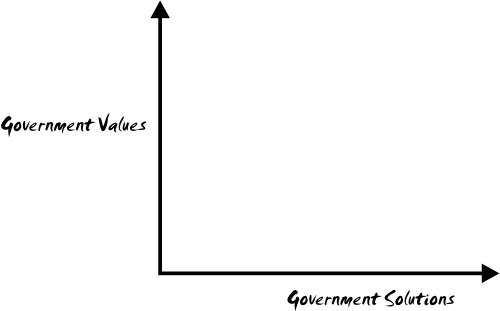
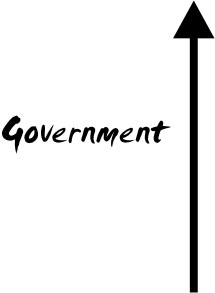
As such, a significant part of the Republican party now believes that the definition of Republican is "traditional values, woven into government." I think this notion is best represented this way:
They want values elevated, and post-Bill Clinton and myriad political scandals on both sides of the aisle, they want the government cleaned up and brought back in line with traditional values.
I get that. It would be nice. But as you increase the desire on the level of government to represent "traditional values," you can't help but increase the scope of government solutions as well. A yearning for traditional values in government inescapably becomes this:
That's the fracture in the Republican party right now. The limited government folks want exactly that: limited government. The traditional values crowd wants exactly that: traditional values in society.
The two are diametrically opposed. The traditional values crowd wants government-imposed solutions, which can't help but grow the government. The limited government folks want personal liberty.
At one end of this spectrum, there will inevitably be a third party. It might not be for a couple of years, but there will certainly be that. It's just a question of time.