|
 |
RSS Feed  |
a playground of art, photos, videos, writing, music, life |
|
|

You are here
|

Creativity!
|

Get it!
|

I like it!
|

Fun stuff!
|

About me...
|
| |
|
|
|
|
Random Quote
Writing is so difficult that I often feel that writers, having had their hell on earth, will escape all punishment hereafter.
-- Jessamyn West
|
|
|
|
|
|
Page Through Blog: << More Recent Posts | Home Page | Earlier Posts >>
Blog Archive by Month | Blog Archive by Story or Tag | Search Blog and Comments
Define "boring." The American Heritage Dictionary says it is "uninteresting and tiresome." Funny thing, interest... Why don't some women date nice guys? Why do they seem to go for the bad boys? Some of them will answer something to the effect that nice guys give them no challenge. They're boring and predictable. There's excitement in a bit of danger, see. You might have noticed that movie-making in the last 25 years has changed. The pace is quicker today, the edit more jarring and rapid. In fact, some movies - blockbusters even - from the 80's now look downright tedious. My kids have looked at me and wondered why I ever thought the movie I once liked was anything at all. I couldn't answer them, really. But I had to agree with them. No one doubts the impact on society and television that Sesame Street has had. And yet do you know what kids show eclipsed Sesame Street? Blues Clues. Yep, the little green screen show featuring only a guy and his cartoon dog. It became "the highest-rated show for preschoolers on commercial television." From Wikipedia: The format of each episode of Blue's Clues is the same.Steve, the host, presents the audience with a puzzle involving Blue, the animated dog. To help the audience unlock the puzzle, Blue leaves behind a series of clues, which are objects marked with one of her paw prints. In between the discovery of the clues, Steve plays a series of games - mini-puzzles - with the audience that are thematically related to the overall puzzle. As the show unfolds, Steve and Blue move from one animated set to another, jumping through magical doorways, leading viewers on a journey of discovery, until, at the end of the story, Steve returns to the living room. There, at the climax of the show, he sits down in a comfortable chair to think - a chair known, of course, in the literal world of Blue's Clues, as the Thinking Chair. He puzzles over Blue's three clues and attempts to come up with the answer. Yesterday, I commented a bit on Scott McCloud's definition of "closure" which he defines as "observing the parts but perceiving the whole." He describes in his book, Understanding Comics, that the space between comic panels allows the reader to use his or her imagination to stitch the story together. If the scenes are consistently too "slow" and explicit, the comic can be seen as a waste of time. There's no activity for the mind. There's no interaction.Some women who date bad boys don't want the always-sincere, nice guy. They want the tension of watching him be distracted and the drama of re-attracting him, and then the release that accompanies his return is exciting. It's a climactic A-ha! The nice guy will go to work at the appointed time, be with the right people through the day, and return home - pretty much on schedule every day. He might - surprise! - bring a flower or a card, but not danger or excitement. For some women, that is so not attractive. Guys with money, a wandering eye, an extreme lifestyle - they offer more tension and release. More opportunities for closure... Today's movies, like comics, have spaces between the panels/scenes. It's in those spaces, called "gutters" in comic-lingo, that the interaction with the reader happens. If the comic is paced well, it gives scenes that require the reader to provide the story between the panels for continuity. Likewise with the editing process in today's movies, the gaps between split-second action scenes require the mind to connect the action together and that exercise stimulates the mind. Each closure of a gap not explicitly bridged visually in the movie brings a satisfactory A-ha! to the movie-goer. They feel like they get it. And maybe they even have to lean over to their companion and explain what just happened. Blues Clues, though seemingly monotonous, differed from Sesame Street considerably in its approach. Sesame Street dwelt on 20-second to two-minute segments, completely changing the feel of everything as it went from segment to segment. Characters, subject, style, colors - all of it changed. And that worked to hook kids. Blues Clues relied on pulling the kids into the show by engaging their minds in interaction and successive A-ha! moments. The characters, the subject, the style, the colors - all pretty stayed the same. But it was the repeated use of closure that satisfied the kids to reel them in for 30 minutes at a time and rocket the show to its lofty ratings. I proposed yesterday that the more closure we have in our life, the more satisfied we are. I'm not suggesting that we all need mates with a wandering eye or jerky-edit movies or a show that invites our brain to solve puzzles. What I am suggesting - no... what I am insisting, is that we each look for closure and A-ha! in the areas that have strength for us and that we naturally find attractive. The software engineer might be the most outwardly boring guy in the world, but the mental gymnastics he does to solve problems might be scintillating to him. The stay-at-home mom whose kids provide her with surprise all day long... the guy who makes sales calls all day long, and thrives on the conversations he has... Closure is interesting and addictive. |
|
|
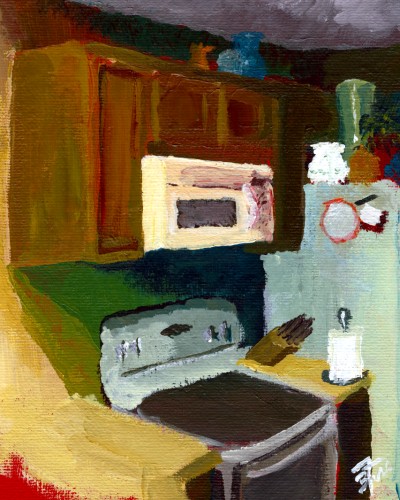 I finished my sketch of our kitchen. I come away from it with a couple of things: - I need to think more about deriving color consistently. Some of that is just being out of practice. Like, in this painting, cobalt turquoise and cadmium orange with a hint of pyrrole red is a good first step toward brown. If I am unfamiliar with the pigments I have in front of me, a bit of work on the colors I intend to use is a good idea before kicking into high gear and applying the wrong shade or hue halfway through.
- Lightly working out the rough shapes and markers for positioning and proportion is a good idea. I really struggled with the cupboard next to the frig.
- Color temperature is important, especially for light and shadows. I don't remember that nearly enough.
- I have to continually remind myself to forget what I know about the subject. It's not a kitchen - it's blobs of layered color.
It looks like our kitchen. After I paint a few other things for practice, I think I'll come back to it.I've been using the filbert-style brush, and I'm getting more accustomed to it. Oh, and I've found that I like the torn-edge look. I have some specific ideas around that and I am eager to try them out. I'll do the next one this weekend. |
|
|
My son, Aaron, gave me Scott McCloud's book, Understanding Comics, for Christmas. I'd had Scott's more recent book, Making Comics, and loved it, so Aaron's gift brought me more enjoyment. It is my favorite gift from this Christmas (along with the combo birthday/Christmas digital SLR camera gift I got from Tamara...) Both are pretty deep books. If you read them seriously, you come away with a deeper appreciation of ways to communicate, and a more robust view of how we look at life. One concept I encountered in the book is that of Closure. Scott defines closure as "observing the parts but perceiving the whole." Think of a dot-to-dot exercise. As you draw the line that connects one dot to the next in sequence, the intended image becomes more obvious. There is a moment where your brain grasps what the image is. Prior to that, there is a minor tension built by curiosity and the little guesses that your mind makes as you try out different images mentally while connecting the dots. And then there is that moment of "Yes" when you've figured it out. There is the release, the A-ha! moment. For those musically-inclined, this happens with music, when you hear a chord progression and you expect that final obvious chord or note. It's that knowledge of what will bring about the expected release that allows musicians to jam with one another without a script or sheet music. They hear the progression and sense where it's going and plot their own course to all meet musically at the same place at the same time. It feels magical when it happens. It's the same thing when I ask you to complete this pattern: 1, 2, 3, 5, 7, 11... What's the next number? Study it for a moment before proceeding... You might say 13. But what if I said it was 15... That probably makes no sense to you, and if that's true, you might feel a bit of tension. It might have looked to you like a prime number sequence, right? Which it is, except that I threw the number 1 in there, which is not a prime number. No, instead look at the difference between the numbers. This pattern emerges: 2 - 1 = 1, 3 - 2 = 1, 5 - 3 = 2, and so on, to create this repetitious pattern: 1, 1, 2, 2, 4... And 4 would be the next number, which requires the next number of our original sequence to be 15, because 15 - 11 = 4. And so if that makes sense to you now, there's the release - that A-ha! moment where the world is resolved. That's what Scott means by "observing the parts but perceiving the whole." He calls that "Closure." Except that he put it in terms of what our brains do to connect the panels of images we call comics. Our brains are wired to perceive patterns and complete sequences. He even classifies types of closure - some which require more effort to connect the dots. For example, complete the sequence: cup, drawl, elevate... What's next? (No peeking - think on it for a minute before reading the next paragraph.) If you're like me, you don't have a clue. The reason is that I chose them as complete non-sequitors, the last of Scott's classification of closure. The problem is that I gave you the expectation that there was a sequence, and so your brain initially tried to connect the dots, and so you might have had to make something up to complete the sequence because the solution is not obvious. (You might have noticed that I chose a c-word, a d-word, and an e-word. Perhaps the next word should start with "f" and be nine letters in length. Why nine? Because the length of the first three words are three, five, and seven - respectively. The next in sequence is therefore nine letters. So "fiduciary" completes the sequence with some semblance of logic. Closure!) So here I'll pronounce a theory: the more closure that we have in our life, the more satisfied we are. Now I've been noodling this through for a few weeks since I first read it, and I have a lot more to say about it. But mull that over... and stay tuned! (Scott's web site, by the way, is scottmccloud.com.) |
|
|
I've always said that desire is 90% of success. I just want to clarify that. There are some really lazy people who "desire" a lavish lifestyle. But their "want" is not desire - only wish. Wish has nothing to do with success because there is no effort behind it. It's as though they expect it to fall from the sky or from the coffers of other people. No, no. If you're not willing to work for something, you don't truly want it. This is especially true in relationships - although the relationship can only be as strong as the person with the weakest desire. Want is not a bad thing. True want will propel us toward work and persistence, which most often leads to some level of achievement and reward. Wish without work is a bad thing. It leads to jealousy and bitterness and relies on magical thinking. |
|
|
Yeah, I just needed more time to get used to the standing thing. I don't even think of it now. And I changed some colors. Cadmium orange, pyrrole red, cobalt turquoise, and yellow ochre. Kept the turquoise - didn't want to give up on it. I realized sometime last night in my sleep that muted colors would work better. Tone it down was my waking thought... seemed right anyway. 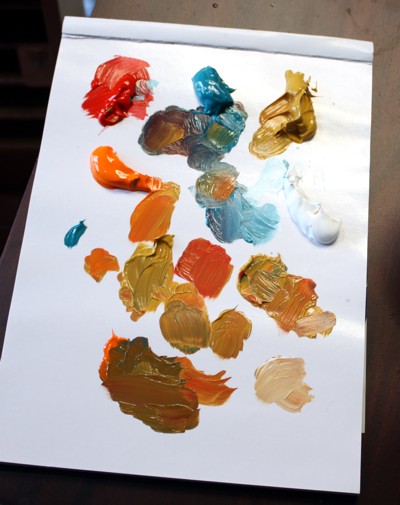 Palettes always fascinate me after I'm done with them. This is about 30 minutes in... amazing the colors you can derive from just a few simple paints. Thus far, here I stand... 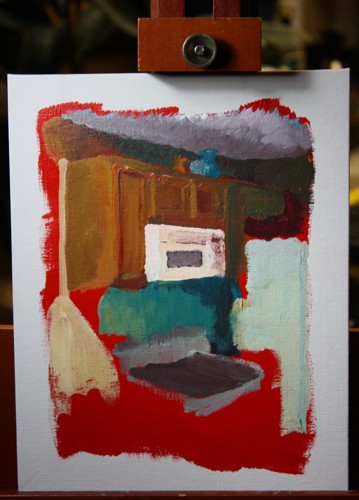 It's better than yesterday. The colors flow better. I'll tackle more tomorrow. |
|
|
Two steps forward, one step back... Where last night I loved my color choices, tonight - not so much. But where last night I blew some of my lines for not concentrating on seeing, tonight I got that part right. I did something for the first time tonight also - I stood up while I painted. 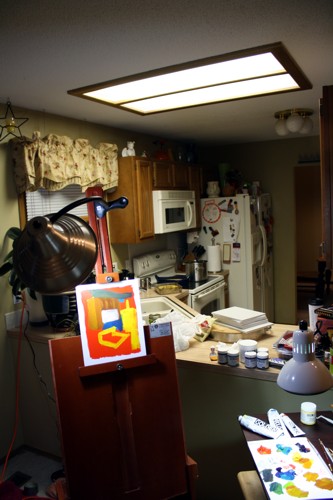 I discovered that I am much more at ease and in control when seated. Does this mean that I just need to get used to standing? I have no idea. But I do know that I had a harder time controlling the brush and seeing the color palette for the overhead light reflection. So I get this for my effort... 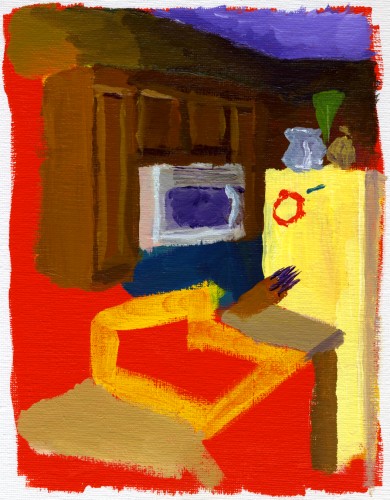 I'm obviously not done, and instead of trying to finish this, I want to redo my color choices and start over. I tried cobalt turquoise tonight. I think it's a good choice for cool shadows (cool, as in the temperature). I don't think it blends easily with other colors. Not gently, anyway. But I had a good time listening to Vivaldi and practicing forgetfulness. The more I look at this, the more I'm convinced that I lost the harmony of the objects. The frig, for example, is completely its own painting and wasn't done with any consideration of the rest of the scene. Selfish appliance... I think I've been away from actual painting for too long to try something this busy right now. I'll try standing up again and see what happens. |
|
|
What I forgot to do yesterday in painting was to forget that I was painting the corner of a room with a lamp, ladder, and blanket. I missed the crooked nature of the upper right part of the ladder. I misaligned a couple of proportions. If I had remembered to forget, then I would have painted it all as I saw it, and not painted part of it as I thought it was. Big difference... Tonight, I'll swing into our kitchen and paint that, I think. Hopefully, I'll remember that it's not a kitchen. |
|
|
Did a painting tonight for the first time in a long time. This is the corner of our family room... 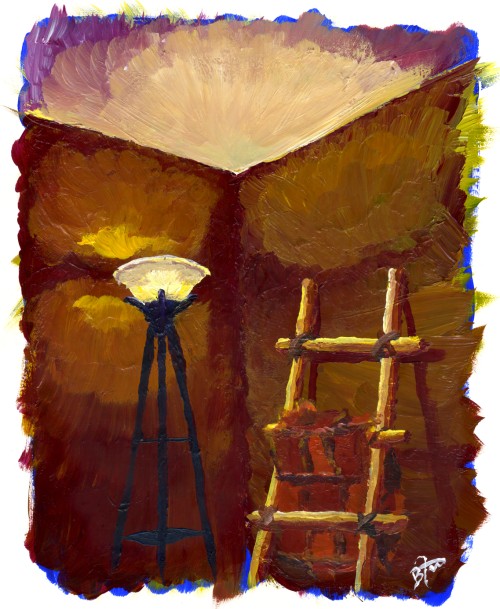 Had a good time with it. I feel like some of the things I've reconsidered in my art over the last year are paying off. If I had it to do over, I would paint the blanket on the rough hewn ladder a bit brighter. Interestingly, as I worked on it, my choice of colors changed and turned out to be just four colors (other than white): medium cadmium yellow dark, quinacridone violet, ultramarine blue, and a touch of light cadmium red for use on the blanket. I'm ready to paint more... ETC: As a reality check, I decided to take a picture of the scene I painted. 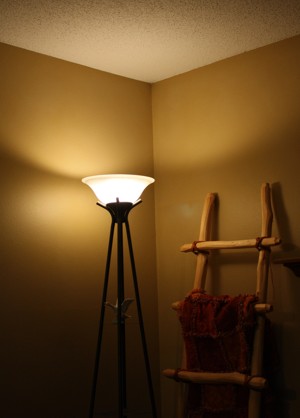 I didn't paint from a photo, but instead painted what I saw in front of me - plein air, as it's called. I want to paint other scenes and other things from my home. It's gnawing at me, like a craving. Funny how this has hit me. And hard, too. I guess I've been pregnant with painting, and the labor has started. It's about 1 AM and I really want to dig into another one. But I should go to sleep instead... |
|
|
On Saturday, Tamara and I pretty much spent the day together as most of our kids were away doing other things in other cities. Prior to that, I'd been working a great deal (sometimes as much as 14 hours a day), and with the travel over the holidays, while we'd spent time together, it wasn't really "alone" time. So yesterday was kind of a PJ day for just us. Tamara went out and got a bunch of movies and we curled up on our new big comfy couch. Among five movies, she picked Sisterhood of the Traveling Pants and its sequel. In the sequel, one of the girls had held a grudge against her dad since the day her mother had died. The mom committed suicide. Some events that led up to her mother's death helped the girl conclude that dad was guilty in part by either contributing to the reasons that led to the suicide or by neglecting his wife's needs. Later, after obtaining more context by visiting her grandmother, the girl realizes that her dad was not only doing everything he could to help his wife, but he was also hurting, and that her treatment of him was just one big long fester on top of his personal pain from losing the wife he loved. Judgment... if I could create my own definition of it, it would be that we critically weigh the choices of others to determine first if we agree with those choices and second whether malice played a role in the decision for action. That said, I wonder how often we assign "intent to hurt" to the choices and actions of someone else when that wasn't the case at all. I've heard the phrase before "Walk a mile in my shoes and then judge me..." The girl in the movie realized that some of her dad's choices were made with the best of intentions. She also realized that she hadn't given her dad the benefit of the doubt. As Tamara and I discussed this later in the evening, she mentioned that very thing: the benefit of the doubt. When we don't understand the choices made by someone, our natural instinct is to fill in the blanks as best we can. Depending on our own internal wiring and experience, that can be negative, positive, or wait-and-see. Are we cynical? Or do we lend the benefit of the doubt? How do we judge the choices of others? It seems to me that the harshness of our judgment scales like this: At the low end of judgment, there's forgiveness built right in: He couldn't help it. Either he didn't know enough or he operated on instinct or training, but it's that "He had no choice." We don't judge animals for painfully ripping other animals into bite-sized morsels. They can't help it. But some people harshly judge humans for that same action of hunting and killing animals. Why? They perceive that people have a choice. Then there is the selfless act. Nobody judges that poorly, but because it is a conscious decision (not instinctual) it lends to bolster your street cred with humans. The more sacrificial it is, the greater the perception of goodness. (I'm not talking about when someone is generous with others' money or time - that's not selfless. Quite the opposite...) Finally, there is the selfish act. Choosing what's in your own best interest seems to cause some folks a great deal of heartache and renders a lot of judgment. Here, I think some political leanings are drawn. I think business too, because it is by definition profit-oriented, is self-centered and therefore judged harshly. Now along these axes of instinct and choice, and selfless and self-centered, we can factor in things that color judgment: Intent to hurt
Deception
Jealousy
Revenge Tamara and I also watched This Christmas. In it, one person viciously beats the crap out of another person with a belt. In fact, they poured baby oil on the tile floor to prevent the other near-naked person from defending themselves while getting whipped with the belt. Sounds bad, I know. How does it flavor your perception of it though when you learn that Regina King's character was doing this to her husband because she knew that he was cheating on her and she finally unloaded her anger about it? Her self-centered choice becomes justifiable to us. And even funny in the movie. You go girl! Beat that two-timing jerk! There are two parts to judgment: the interpretation and the response. It seems to me that personal interpretation needs to be softer and more patient. Our system of justice is patterned after this. It seeks a full disclosure from all sides so that as full an understanding as possible is gained before the response is given. But in the busy moments of our day, it's tough to give time to that. As a parent, there've been times that I've judged one of my kids too quickly and later learned more of the facts I should have taken the time to acquire and I came to see that my response was completely wrong. |
|
|
Drawn on my Verizon LG Dare Drawing Pad: 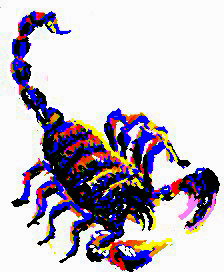 (You can sign up to have a new drawing sent to you daily by picture message.) |
|
|
|
|
|
|
|