a playground of art, photos, videos, writing, music, life
You are here
Creativity!
Get it!
I like it!
Fun stuff!
About me...
Random Quote
Who wants to become a writer? And why? Because it's the answer to everything. To 'Why am I here?' To uselessness. It's the streaming reason for living. To note, to pin down, to build up, to create, to be astonished at nothing, to cherish the oddities, to let nothing go down the drain, to make something, to make a great flower out of life, even if it's a cactus. -- Enid Bagnold
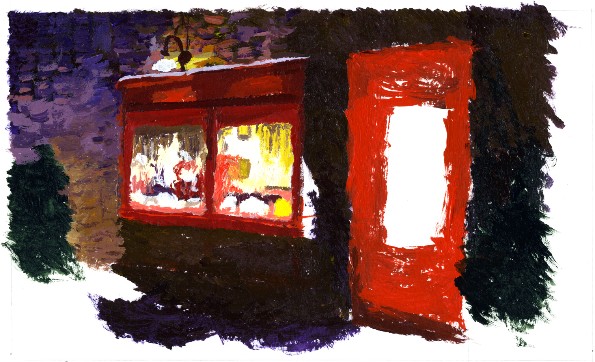
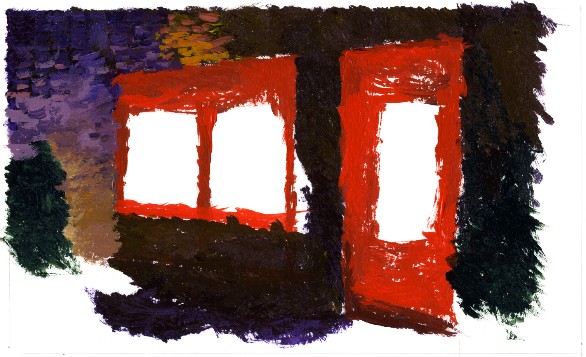
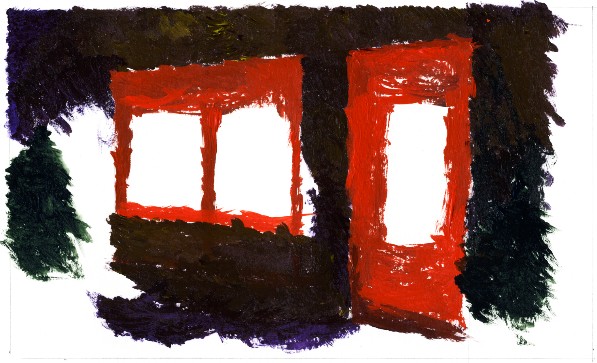
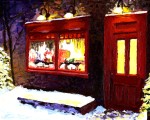
Working on the painting tonight and I think I've decided on the title "Holiday Glow." I reserve the right to change my mind of course, but that seems fitting enough for now.
I have detail work to do on the sections that are new, but it's coming along fine, I think. I do need to fix an angle problem that I have in the store window, but I'll get to that in the next go pass at it. (ETC: Now somewhat fixed... at least the angles are better...)
I brought the humidifier out of the shed today and I have that going beside me. With acrylics, I need humidity, otherwise the paint dries too fast to remain useable for long.
I also video'd my work in a trial of youtube... I'll upload that when the video is done cooking.
I tweaked the beatcanvas site so that on the left side now you see "Stories." Pretty much all blogware shows content in reverse dated order, so that the most recent entries are first. But that makes for a lousy story - stories are never, "The end... The princess kissed the frog... Once upon a time." But that's the oprder in which a blog tells a story.
I wrote beatcanvas' blogware to show "threads" - which would show the entries in true chronological order. "Thread" is an overly geeky term that no one would understand. Pardon my nerdness. "Story," on the other hand, is universal...
If you click on any story links here at beatcanvas, you get the tale of whatever the topic in proper dated order - from start to finish. I think this is the right format to tell the story of each painting, and for other things as well. Enjoy!
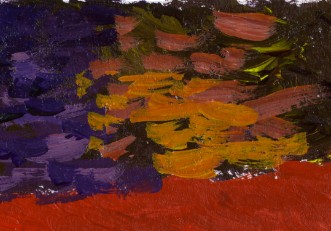
I'm working on the stone wall of my next painting tonight...
...and I'm reminded how very much I enjoy purple, red, and yellow.
It's such a lovely combination of color.
I'm using my small brush and enjoying that too, where I painted my previous painting entirely with the mid-sized brush. Funny how a change of brush can articulate in a completely different voice.
The real trouble with this world of ours is not that it is an unreasonable world, nor even that it is a reasonable one. The commonest kind of trouble is that it is nearly reasonable, but not quite. Life is not an illogicality; yet it is a trap for logicians. It looks just a little more mathematical and regular than it is; its exactitude is obvious, but its inexactitude is hidden; its wildness lies in wait.
Humans are creatures built to recognize patterns. We look for patterns so that we can know things, and once known, we can then move on to knowing other things. A smile = friendliness. A car moving toward me = danger. These are things we learn, know, and then our reaction to these become instinct and not something thoughtful. This is the efficiency of being human. It allows us to multitask. We anchor to things taken for granted that now exist on our periphery.
I've said in the past, as an axiom if you will, that anger is borne when we don't get our way. We don't always get angry, but if you find yourself mad, it's because the results you expected and wanted didn't turn out that way. The patterns we know and expect are no longer true, and our foundation of truth in the world becomes questionable.
Generally speaking, humans don't care much for change. We're not looking for chaos, but chaos seems to be looking for us these days. We refer to variety (chaos) as the "spice of life," but most of us don't have a palate for habeñero peppers. Know what I'm sayin'?
In relationships, we find constantly that people aren't always logical. They won't fit our patterns. Sometimes this is a good thing, such as when our partner appears with lunch in hand and a hand-written note telling us how special we are to them. This is a pleasant and welcome surprise.
Other times, we find change afoot in our partner or in our relationship, and we have to invest the time to get to know the change and to reacquaint ourselves with these new patterns. Too much of this will squash a relationship. Too little might bore us. We all want "just right."
People are, at best, "nearly reasonable, but not quite." Thus, the craziness inherent to relationships; our partner does what we don't expect, and vice versa. And so perhaps we try to form fit each other to the patterns with which we're comfortable, or we adapt ourselves to these new patterns. Which is why some people just opt out of the whole thing. "Too much work," they sigh.
In relationships, "wildness lies in wait." It's to be expected and sometimes it's a white-knuckled ride.
I've heard the maxim before to "know your audience." Edward Tufte tells us that this generally leads to dumbing down our message. I so get that.
Instead, he offers, we ought to focus on our message, and he quotes Gore Vidal: "Let the writer write, and let the reader read."
Edward Tufte is known for his ability to make the complex digestible. This started with a quote of his that I read from Tom Peters web site where Edward says, "To simplify, add detail." Okay, that's a head-turner of a phrase.
I found no help in interpretting that quote, and I don't find it intuitive or obvious. I do, however, feel something simmer on the backburner of my brain. I'm cooking on this notion...
I think I find some help, via the link I provide above, when Edward says that we ought to "reduce impediments to learning." Adding detail to something is a means to answer the questions that burble forth when confronting a troublesome concept. I think for most of us, when presenting complex material, we want to reduce it to bullets or charts. And that can be helpful. But if the reader truly seeks understanding, we make it easier to understand when we provide detail and background that the user can drill into, if necessary. Understanding brings the "A-ha!" sense that we hope to invoke in our audience. Then our point is obvious and we've truly communicated. This may be the simplicity of which Tufte speaks.
No one listens well when we dumb down our message. That's not knowing our audience; that's condescension. Rather, when we challenge folks to come forward and join our perspective, then our audience knows us.
I've only been painting a short period of time, but I've got some tips and tricks for anyone who might want to hear. I figured while I'm home today with a sick child who is now resting, I might jot these down.
Tip #1: If you want to paint, then paint! I know it sounds silly to have to say it, but it's much like Virginia Woolf said: "The art of writing is the art of applying the seat of the pants to the seat of the chair." The same is true of painting. If you want to accomplish something, then first move to the place where you would do it, and then do it.
Tip #2: Embrace fear. I feel inadequate to work with quality on every painting that I begin. It's true. But I ignore it and dive in anyway.
Tip #3: Embrace "failure." I'm okay with failure. Neither success nor failure define a person, but the effort. And my past success is no indication of my future result. In fact, success can heighten my expectations and intimdate me from trying. To hell with that.
Tip #4: Paint exactly what you see. Painting itself is not a matter of dexterity. It's 50% a matter of seeing things truly. (The other 50% I'll get to in a moment.) But it rests in the ability to see things as they really are. That apple might be red in parts, but it is a wide array of colors in the spectrum if you really look at it as it truly is.
Tip #5: Learn colors. Mix colors. Take every color in your palette and mix each with the others and learn the combinations of them. Learn which ones are weak and semi-transparent and which ones are strong and opaque. Color is such a powerful tool in an artist's hands. This is the other 50%. Whatever else follows is style, I think.
Tip #6: No black. I left black out of my color palette a long time ago, and I'm much better for it. If I need "black," I mix deep browns (blue-orange, purple-yellow, red-green) or I mix blue and green and red together. Or I use a strong purple. But each of these have a warmth to them, and frankly, "black" just isn't in the world. It's flat and lifeless. Seriously. Look around. It's hard to find.
Tip #7: Limit your palette. Paint harmonizes better with fewer colors. I generally start a painting by choosing the 4, or at most 5, colors I plan to use. White is always present, but I try to use it sparingly. It pulls the life from a color when mixed.
Tip #8: Learn composition. The more the eye darts around the painting, the more interesting it is. If something is front and center, like a portrait, there's no discovery or movement.
Tip #9: Less is more. If the brain has to work a bit to assemble the painting and fill in the blanks, the more drawn people are to it, in my opinion. I'm not talking Jackson Pollack in terms of making the brain work, but an exact replica of life doesn't require any imagination or bend us in any way. Like people, a painting becomes more interesting when it's not "perfect."
Tip #10: Mix up your subject matter. Try new things. Paint trees, people, animals, houses, nature... enjoy the challenge of new subject matter.
Tip #11 Get rid of the yellow lights. Look at the difference between a true artist's white light and the light bulbs you buy at the store. I don't care how "white" the store bulbs purport to be - they're not white. True, white bulbs are expensive, but oh so worth the cost.
I have a few serious problems with the Republican party at the moment.
Spend happy nature. Too many Republicans in leadership positions have seemed to think that government spending on their choice, pet projects is a worthy endeavor. The creation of a public database to track earmark spending is now law, but would never have been so if not for the blogosphere on the right and left. And it saw daylight in spite of a "secret hold" by a Senate Republican.
Bush's hesitancy to sign into law the Secure Fence Act. This is National Security 101 - it doesn't take a rocket scientist to figure this one out. Leaky borders = national security threat. But Bush is hemmin' and hawin'. Um, yeah...
I mentioned recently the matter of Rep. Foley and the mishandling of him by House Republican leadership.
If Democrats would be serious and have a real plan to conduct the war on terror, I'd be ready to pull the lever in November for Democrats this time, if only to help give the Republican leadership a vote with my feet and a clear wake up call. Not that I expect Democrats to be any more ethical or principled - I don't. But "conservative leadership," by definition, should be both conservative and leadership, and I'm seeing a very spotty track record in the issues I've raised.
Our leaders in government should:
Have zero tolerance for those who break the law, no matter their political stripe.
Disallow sexual harassment and the predation of minors.
Seek to secure the US from any terrorist threat.
Lose the notion of our tax payments being a barrel full of goodies for them to raid.
Duh... as if any of those were arguable at all.
As I watch the Democrat left eat their young (or old, in this case, in the form of Lieberman vs. Lamont) over the war in Iraq, I wonder who exactly does deserve any vote this year. It's all quite infuriating.
ETC: Bush will sign the Secure Fence Act into law later this month. And earmark transparency was signed into law. Pardon my grumbling... I dunno. The Republications have always been shitty with PR, and this just goes further to that point. So let's look at the bright side:
Foley was canned and will go through investigation by the House.
The Secure Fence Act will be law.
Earmarks will be publicly searchable.
We're five years after 9/11 without a terrorist attack.