|
 |
RSS Feed  |
a playground of art, photos, videos, writing, music, life |
|
|

You are here
|

Creativity!
|

Get it!
|

I like it!
|

Fun stuff!
|

About me...
|
| |
|
|
|
|
Random Quote
A novel is an impression, not an argument.
-- Thomas Hardy
|
|
|
|
|
|
Page Through Blog: << More Recent Posts | Home Page | Earlier Posts >>
Blog Archive by Month | Blog Archive by Story or Tag | Search Blog and Comments
|
|
Stephen Covey taught me about the Circle of Concern and the Circle of Influence: while I may be greatly concerned about something, I may not have any control over it. If I spend a lot of time there, I'll be wasting my time. Time is best spent in areas where I can have impact. Therefore, in a complete departure of habit, I will no longer read news web sites. I once knew a guy named Barry Lawler, who was my landlord for a time when I lived in Corvallis, Oregon. I also painted his historic house. Barry never listened to or read or watched the national news. He thought it a complete waste of time. He was right. I'm working on some new habits to develop in my life. My re-think of my Rules of Life is coming along well, but this one bubbled up and it will most likely be the hardest. Could also be the healthiest. On occasion, I will continue to read blogs and such that I find helpful to me, but news sites ain't it. |
|
|
I picked up the first 1,750 mini-cards from the printer and got the proofs of the next eight designs, which will come in next Wednesday. If I didn't mention it, I'll offer these in a variety package of cards, 1 card each of fifteen different designs. Here's a snapshot - note the quarter at the bottom of the picture. 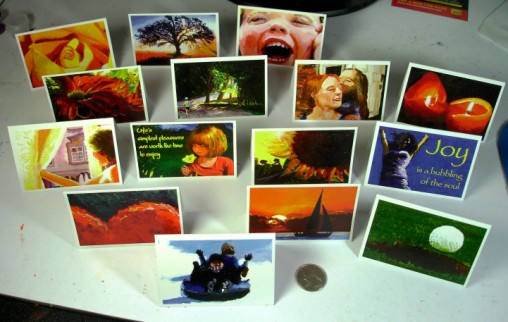 I was planning to use a zip loc bag to package these, but Tamara recommended, and rightly so, that I use something else - of which I'd never heard - called an "organza bag." 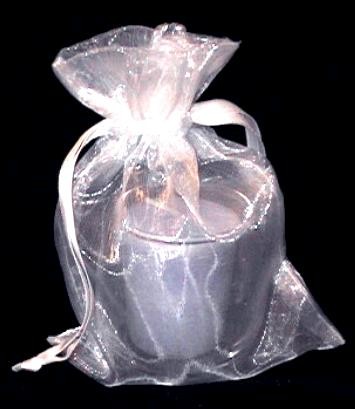 Nice presentation... I have a box of them coming to me to see what they're like. So - inside the shimmery bag, for $11.99, you'll find the 15 cards, 15 envelopes, and a piece of paper with text something like this: The Connection PackageStrengthen your personal and professional relationships with these vibrant and unique cards. Small enough to fit in a wallet - memorable enough to leave a lasting impression! Use these cards: - In the office with colleagues
- On gifts as tags
- To accompany flowers
- As back pack or lunch box notes for your kids
- As invitations
- Just because...
Connect with Someone!(You can also buy a dozen of the same card for $11.99.) I feel like after spending over $3,000 of my money, I need to focus on marketing. I'm nearing the right product. How do I pitch it? At work, I have eight orders thus far, which is pretty much an order per person who has seen the cards. That's hopeful! |
|
|
I picked up the card proofs today from the printer. 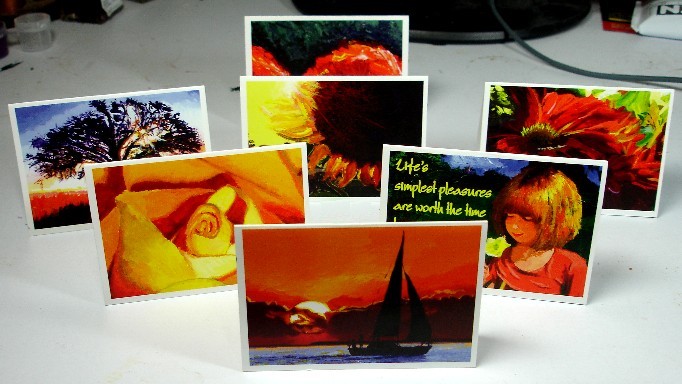 They're just a little taller than business cards. 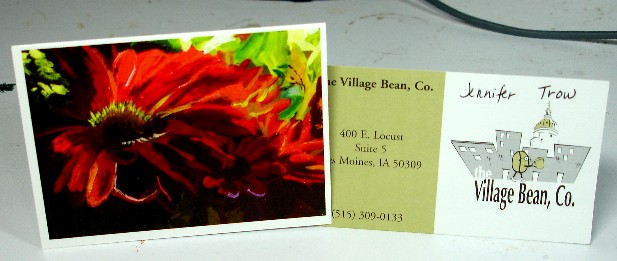 I should get all 1,400 on Friday. Of course, I've gotten cards from the printer before, but Chuck, the sales guy, made the comment today for the first time that he finds my work very emotive and that he wants to buy my cards. That's the first time that a guy has made a move to buy my cards. Could it be? When I first started my cards, I knew that 95% of all card buyers are women, which to me spoke of the opportunity that men present if I can find a way to tap into the market. These cards, small (heck, even tiny), don't intimidate, where my big cards do. I get them home and my son, Aaron, says, "These are the perfect size for little kids. Like for party invitations." Tamara and I spent part of the evening talking about packaging and marketing. She, being a most excellent seamstress, has some ideas that she wants to try. You go girl. Not my bailiwick. I just love this card business. It's fun... it feels like I'm headed in the right direction. ETC: The reaction I'm getting is good enough that I've created and ordered seven other designs, based on my work of course. |
|
|
Tonight was a mindblower. If you read this site on a regular basis, you know that I've disagreed with Bella frequently in the comments section, and one of those lines of disagreement was over my cold, hard Rules of Life. "Meanie" was a term that she called me. But Bella knows me personally as a warm person. From where did this cold front originate? I once asked her the question, "Do you think my web site represents me?" and her response was "No." To know beatcanvas.com is not to know Brett. It's a side of me, to be sure, but not an accurate picture of me. It was about five years back that I wrote up the Rules of Life list. It covers a lot of ground, everything from personal responsibility to business success to parenting and so on. The goal was to find axioms that, when applied, are universally true. It searched for principles and mathematical accuracy. I went through that list with Tamara tonight, who was very honest with me. In reading the rules, some are spot on and I wouldn't change a thing, but others are simply wrong. In fact, after reading it, I came away realizing that I didn't recognize the person who wrote that. For some of these, I'd side with Bella on the accusation of "Meanie." When I first separated from Jamie in 1992, I decorated my apartment in black and white. Later, when I got the divorce, I went to Wal-Mart with my daughter, Bari, and bought green plates and glasses. I remember thinking how beautiful those looked against my memory of the white ceramic plates with the black pinstripe border. And I remember going back about a year later and buying a white plate with blue, yellow, and green flowered edges. I've slowly introduced color into my life. Interesting to me, if I fast-forward, is that I no longer use black in my paintings. What you see as black is either a dark green, dark purple, or a mixture of green, red, and blue. Or a complimentary color brown. But black, as a color, is never part of my palette any more. What's more, being an artist now, I know that red isn't just red. It depends on the context. Red against blue is not the same as red against yellow, for example. It might have started out from the tube as the same color of red, but juxtaposed against a different backdrop of colors, it will appear differently. Check this out: 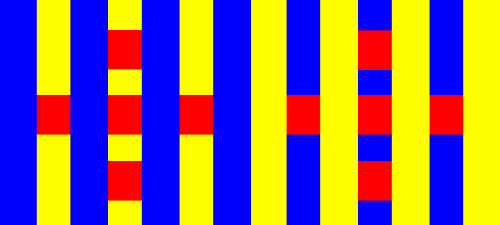 Notice how the red is lighter on the right than on the left. But it's the same red. (See this site for more fun with color illusions...) Or how about this: 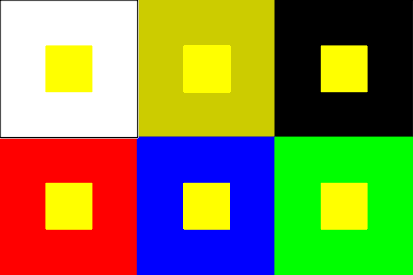 Yellow isn't just yellow any more. It's changed by what's behind it. I'm reading Tipping Point, and it's getting into the importance of context in understanding epidemics. I'm noticing some synchronicity here. My vision is not large enough. I'm missing the context. Life is not formulaic. And so I look back on all the black and white decisions and conclusions I've determined and all of it is suddenly suspect. I need to rethink and rewrite the list because I no longer draw in pencil - I now paint with colors. And I wonder: are there really any Rules of Life? I think color and context change everything. I'm suddenly reminded of someone's quote: "I'm not young enough to know everything." This one comes to mind too: "Knowing is the enemy of learning." I get that. I feel remarkably naive. I'm glad for that. |
|
|
|
|
One of my favorite books is Five Star Mind, which has a somewhat arrogant title for such a humble book. The subtitle is "Games and Puzzles to Stimulate Your Creativity and Imagination," but that completes misses the point of the book. Released in 1995, it was a pre-cursor to Aha! and A Whack on the Side on the Head. It's a book on how to approach life from new angles and arrive at new creative vistas. It's engaging and fun to read. Tom Wujec, the author, says this about creative tension. To be creative is to take a risk. Every new beginning - it could be an essay, a symphony, a computer program, a business plan - is as hard and as chancy as every other beginning. Starting a creative endeavor calls upon our courage to put something of ourselves on the line. For some people, the spontaneous drawing exercise is very challenging. They can't get used to the feeling of not knowing what they are going to do before they do it. And for other people, the exercise is liberating and exciting - it's a chance to let ideas flow out of the without inhibition.Because we experience a chorus of moods throughout any given day, there will be times when we confront uncertainty, anxiety, and the dragon of fear. Great creative individuals don't have any less fear when they stare at the blank canvas or catch a glimpse of the audience before the performance. In fact, they probably feel more. But what distinguishes them is that they consistently engage their fear, put it aside for a while, or step boldly into the heart of it, turning anxiety into energy. Action transforms fear into vitality. The feeling of doing something without knowing where it may lead you is something a creative person learns to tolerate, appreciate, and love. The seasoned creative individual can be uncertain of where he or she is going while at the same time be certain that the destination - wherever it may be - will be interesting. [Emphasis mine.] The less seasoned creative individual feels lost and disoriented in creative tension. With a need for quick resolve and closure, they lose sight of the need for the periodic mucking about in the dark to produce something of value. Marvin Minsky from the M.I.T. artificial intelligence lab believes that tolerating displeasure is not only an integral part of the creative process, but central to learning it. He writes, "In the early stages of acquiring any really new skill, a person must adopt at least a partly antipleasure attitude.: 'Good, this is a chance to experience awkwardness and to discover new kinds of mistakes!' It is the same for doing mathematics, climbing freezing mountain peaks, or playing pipe organs with one's feet. Some parts of the mind find it horrible, while other parts enjoy forcing those first parts to work for them. We seem to have no words for processes like these, though they must be among our most important ways to grow." Creative individuals tolerate and even thrive on this creative tension. I've seen people addicted to creative anxiety, who live in a perpetual state of turmoil, feeling continually restless, deprived, empty, and unbearably frustrated until they express their inner life in some creative way. Out of this chaos emerges something new and exhilarating. Can we learn to enjoy feelings of tension and confusion? Certainly, in moderation. To believe fully in your ability to get things done, and at the same moment, to have doubts, isn't necessarily a contradiction. It is a way of walking through the creative uncertainties and managing your creative flame. Your confidence builds with every success. The more you solve problems, find ways out of dead ends and discover inspiration when you thought you had exhausted all possibilities, the more you encourage creative anxiety to stir up ideas rather than char them. I highlighted the one section because I relate to that. I've said before, but it's true: every time I approach a painting I never feel as though I'm ready for it. I have some fear around it, particularly if it's going where I want it to go. The further I get into it and the more I have success, the more I'm afraid that I'll screw it up. But I have to be okay with that fear. In fact, we all do. Life is like that.So are relationships. Our friendships in life take us by the hand and we have no idea where they will lead us. We explore, we learn, we grow through the experience. Think about this in terms of friendships: [We] can be uncertain of where [we are] going while at the same time be certain that the destination - wherever it may be - will be interesting. Do we "tolerate, appreciate, and love" embracing others in our lives and enjoy the moments that we have with them freely? Or do we throw expectations at them and then get mad when our expectations don't come to pass?I think there is tension, to some degree, in all relationships. The more that we want from someone, the higher the tension. That tension is relaxed as the other person either agrees to and meets our expectations or as we let go of these expectations. I think the best friendships have another kind of creative tension. We push each other and see life from the perspective of another in the most honest way and that tension pulls us to be more than we are. Beautiful moments can come out of that. Do we dare? |
|
|
It All Depends on Your Point of View |
Went to the Des Moines Farmer's Market again today with Tamara, and here's what it looked like for us adults: 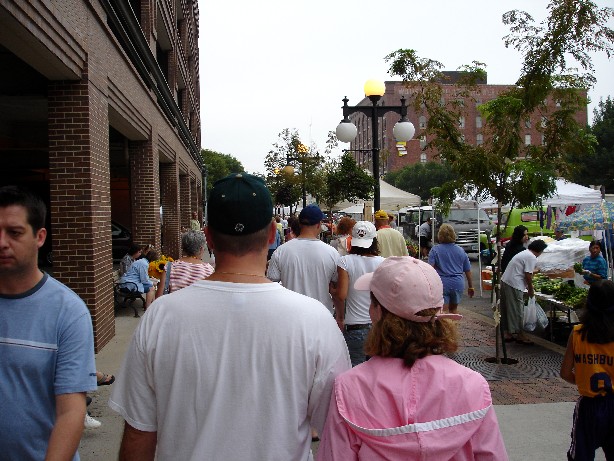 My sons tagged along. Their perspective is completely different.  The Farmer's Market is an interesting place. You see some normal scenes there: 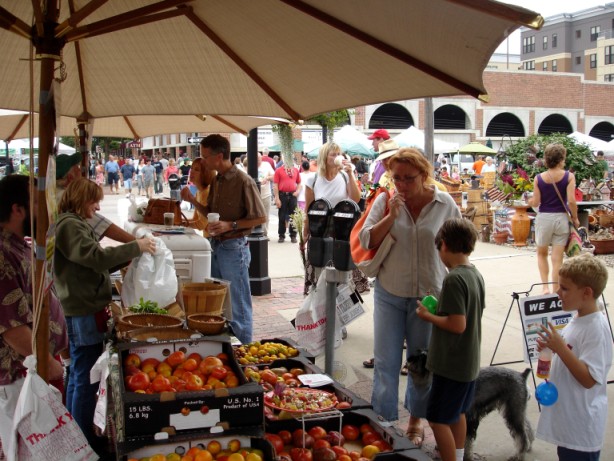 And then there are some unfortunate scenes. 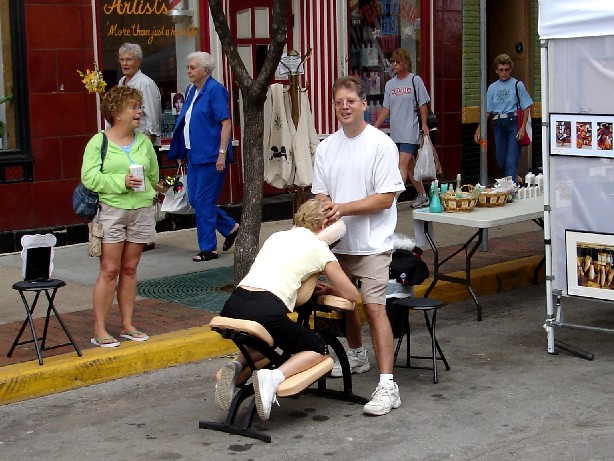 I did manage to capture a bunch of pictures though to finish my big painting, which is what I'm doing next. I'm tired of looking at it sit and collect dust in my bedroom on my easel. Since I will have a table in the Farmer's Market next summer, I might paint some big paintings of scenes from the market and sell them next year. Might be an interesting way to garner some attention to my work. |
|
|
 | Original Artwork For Sale |  |
I've decided to sell my originals. You can view them here. They are $100 each. All for sale but the sunflower. I want to keep that one for myself. ETC: I've sold 9 paintings. I'll be updating my art gallery and listing those that remain for sale on the web site later. MORE ETC: The art gallery is updated. You can see it here. |
|
|
A friend sent this to me yesterday with a bunch of other pictures... but this is a classic. 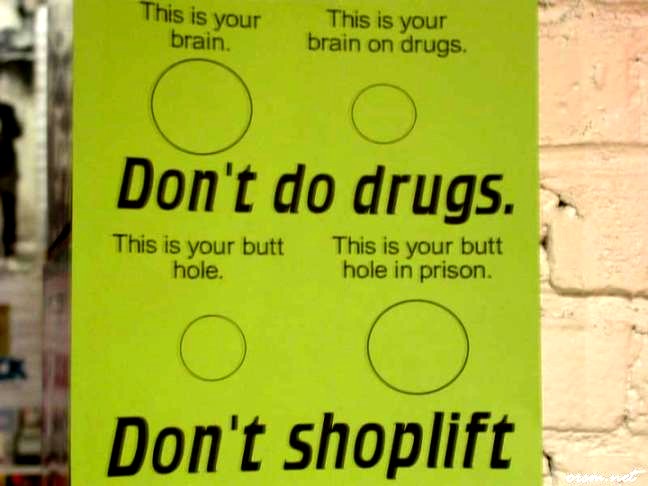 |
|
|
|
|
I almost made a $300 error today. I authorized the printing of my small cards and this morning I went to order the envelopes and discovered that I had misread the size of the envelopes. So I stopped the presses (whew!) and avoided paying for product I couldn't sell. I came home and found that I could obtain 4" x 4" cards, and though they looked good, it felt wrong to me. I'm pretty smitten with the idea of selling a dozen little cards for $11.88. So I scoured the web and found a site that offers little envelopes in odd sizes. This size is very close to the one I first thought I had. I've re-created the cards to the size of 2½" x 3½". This is business card size, but a little taller. Order submitted, and once I see the proofs, I'll order the envelopes. (UPDATE: I've replaced the pictures below with snapshots of the proofs, and I added one more card: the sunflower.) 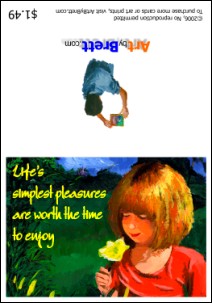 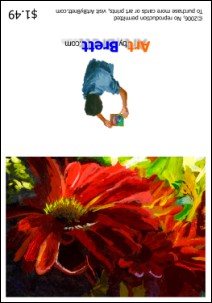 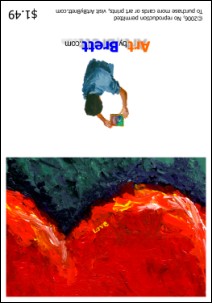 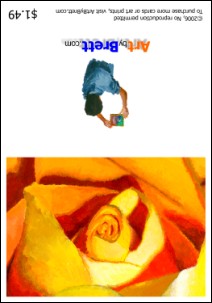 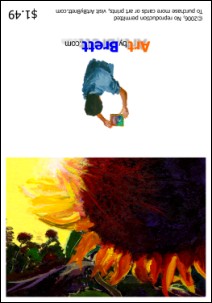 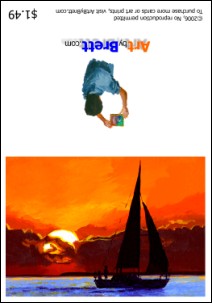 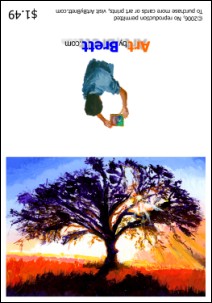 Mercy... I'm glad it worked out as it did, although I think I've driven my poor printer nuts. Oh, and in a bit of good news... at work, it looks as if I'll be working on a marketing project, and frankly, I couldn't be happier about it. I get to listen, react, write, invite, engage, promote, and educate. Right up my alley. Life is great! |
|
|
I've been reading Malcolm Gladwell's Tipping Point. In it, he talks about a concept called Broken Windows, which is the idea that if we "clean up the sidewalk every day, the tendency is for litter not to accumulate - or for the rate of littering to be much less." People tend toward civility more than they want to contribute to lawlessness if their environment is orderly. As Napoleon put it, "A man becomes a creature of his uniform." New York City found that by getting rid of the grafitti and by fixing the broken windows, crime subsided during the 1990's. The axiom would be: take any system that appears broken, and set high standards within the environment that houses the system, and odds are that the system's defects will decrease. My first manager was Frank, when I worked at Friday's. No idea where Frank is today, but his motto was, "Standards, bro." If a table was wobbly and lacked a wobble-stopper, then he would simply pull the chair. The rest of the restaurant was similarly treated. When he interviewed me for the job of busboy, he asked, "How fast do you run the hundred yard dash?" That was Frank. Under his leadership, we were Store of the Quarter for the entire Friday's chain for two or three quarters in a row. The axiom being: the higher our standards, the less likely defects will find their way into the system. That may seem obvious, but think about it. We will live in a world increasingly flat and devoid of recognized leadership. In order for standards to be implemented, we need to recognize a leader who is unafraid to issue standards for behavior and we need to respect that leader enough to live up to the standards. This implies a culture and organization. But this is the age of the multicultural. It is the age of transience and loose affiliations. How do we set standards today? By example, assuming that others will esteem us enough to follow our lead? I don't know, but I'll be thinking a lot about this in the coming weeks. ETC: I watched The King and I over the weekend. This is a great case in point about standards. Leaders establish culture and to the degree that a leader is recognized by those he/she leads, those who follow will adhere to the culture. The king's servants all dropped prostate to the floor in the presence of the king. Anna, not being a servant, didn't recognize some of what the king said and while she treated him with respect, she more treated him as a peer than as a king. At the end of the film, the king's son, who was taught by Anna and becomes the new king, proclaims that people will no longer bow to the floor in the king's presence, but instead show respect and hold their head and chin high. New culture. Standards are not just declared by a leader, but we declare standards in our own life as well. These run across many axes, such as appearance, manner, work ethic, how we care for our body, et cetera, et cetera, et cetera. (Sorry - couldn't resists that.) I was reading Tom Peters over the weekend and in one of his slides, he gives the 3 E's. Tom, back in the 80's, wrote "In Search of Excellence." Today, he insists that we personally have the standard for ourselves of Enthusiasm, Execution, and Excellence - the 3 E's. Said another way, passionately get it done with the highest quality. What is a standard? Something established by authority, custom, or general consent as a model, example, or point of reference. Notice that there is no hint of the level of quality there. A standard is a bar. It's what is acceptable. We hear of people with high standards and we hear of people with no standards. What do we expect of ourselves? What's the minimum? Do we wear white shoes after Labor Day? Do we iron our clothes? McDonald's or Outback? Daily exercise or never exercise? Sir and Ma'am? Swear words? All of these fit into our standards for ourselves and what we expect of others and what we believe others expect of us. Standards define culture. They are rules, the bright lines of behavior and lifestyle. They determine how we conduct ourselves and how we raise our children. At work, we like to have the expectations of us written down as a point of reference. Do we do this for ourselves? And do we hold ourselves accountable to it if we fail? Is it okay for standards to be a bit squishy? If they are squishy, are they truly standards? Or are standards always non-negotiable? |
|
|
|
|
|
|
|