|
 |
RSS Feed  |
a playground of art, photos, videos, writing, music, life |
|
|

You are here
|

Creativity!
|

Get it!
|

I like it!
|

Fun stuff!
|

About me...
|
| |
|
|
|
|
Random Quote
Any reviewer who expresses rage and loathing for a novel is preposterous. He or she is like a person who has put on full armour and attacked a hot fudge sundae.
-- Kurt Vonnegut
|
|
|
|
|
|
Page Through Blog: << More Recent Posts | Home Page | Earlier Posts >>
Blog Archive by Month | Blog Archive by Story or Tag | Search Blog and Comments
The Customer is Always Heard |
The "customer is always right" - a business cliché - has the right heart, but the wrong direction. It's not that the customer is always right. Sometimes, the customer is wrong. Everyone knows that. By saying the "customer is always right," it's an effort to try and satisfy the customer. Satisfied customers come back, you see. Therein lies the logic. Any business transaction should satisfy the customer - obviously - but it should also satisfy the company. No company stays in business that tries to satisfy everyone by giving away the store. The right direction is that customers should always be heard. Whether a customer is right or wrong, what matters is that they matter. Customers feel significant and respected when they feel that a company has listened to them. "Hello... ABC Plumbing? This is Mrs. Jones."
"Hi Mrs. Jones. What can I do for you?"
"You overcharged me." ABC Plumbing could simply give in to Mrs. Jones and take off the amount perceived as overcharged. After all, the "customer is always right" - right?There's a better way to move ahead with this. "We overcharged you? I'd like to know more about that. Do you have your statement handy? I'd like to walk through it with you."
"Yes, I have it right here."
"Tell me the part that you feel is incorrect, if you would."
"It says here that your man worked for 3 hours. That's not true. He was only here for 2 hours."
"I see on my system here that Jason did the work for you that day. I'd like to call him and ask him about this. What's a convenient time to call you back?"
"I'll be home this afternoon."
"I appreciate that you brought this to my attention, Mrs. Jones. Let's get to the truth about this."
"Yes."
"I'll call you back at 2:00. Thank you for contacting us about it."
"Yes. I look forward to getting this corrected." At this point, whether the time charged her is correct or not, Mrs. Jones has been made a partner with the company in solving her problem. Getting to the truth - whether accurate or not - is now the mission. She knows that the company has completely heard her side of it. She feels valued and important. And if the bill was accurate and she's wrong, Mrs. Jones is more apt to agree to the truth.Taking the time to listen and then taking action on their behalf cements customer loyalty, not give-aways and subservience. The business owner's chief responsibility to employees and customers is to sustain the business. Listening is the best path for continued success. |
|
|
Judge Disses the, Um, "Honorable" Roy Pearson, Jr |
The infamous judge who sued his dry cleaners for $67 million over a lost pair of pants had his day in court. The judge decided against him, showing that America is indeed a just place to live. That's right - the pomposity that is Roy L. Pearson Jr. got the smack down he well-deserved.  The sad thing is that ol' Roy's a judge, who holds court to interpret the law for others, and he somehow believed that the law gave him the right to drag his local dry cleaners through court for two years and sue for an amount totalling over 80,000 pairs of the pants, which had a value of $800, as he gave it. And if that's not enough to believe Judge Pearson impeachable, how about his behavior on the stand? On the witness stand, Pearson broke down in tears and had to take a break from his testimony because he became too emotional while questioning himself about his experience with the missing trousers. Those weren't pants... it was his woobie.In his opening statement, Pearson came out swinging, telling the court, "Never before in recorded history have a group of defendants engaged in such misleading and unfair business practices." Repeatedly referring to himself as "we..." What is he - the queen??Pearson sought to present himself as the leader of a class of tens of thousands, if not a half million people, consisting of local residents he believes are at risk of falling for such insidious business practices as posting "Satisfaction Guaranteed" and "Same Day Service" signs. Pearson said at one point in court filings that he planned to call 63 witnesses."Mr. Pearson, you are not 'we.' You are an 'I,'" Bartnoff told him. Amen.As Pearson explained the details of the missing pants, he struggled to get through his hour and a half of testimony, most of which concerned his credentials and his background.He became visibly emotional when he reached the point in the story in which he recounted a confrontation with Soo Chung from the dry cleaning store. "These are not my pants," he testified, and said he told her, "I have in my adult life, with one exception, never worn pants with cuffs." Pearson testified that Chung insisted, saying, "These are your pants." Pearson then rushed from the courtroom, overcome with emotion. He rushed from the courtroom, overcome with emotion, over a pair of pants?And he presides over justice in court?? Hoo boy. I hope that's corrected as soon as possible. |
|
|
Poolside: 3/4 Done, Sizes and Lines |
 I've got a couple of problems I need to remedy. First, the head of the woman and her left shoulder are inordinately large. That shouldn't be a big deal, though is it is tricky now near the end to fix things such as that. And the water's upper reflection line rings false as it rises toward the right of the painting. I need to make a second pass anyway on the side of the pool and do the necessary detail work, so that should clean it up. I think two more sessions with this one and I'll have it done. Things I've learned: I really like larger paintings and I very much like filbert brushes. |
|
|
Poolside: Photo vs. Scanned |
I finished my work on texture at the top of the painting, and I'm happier with the result. It's not so much that I didn't like the style of the other - I think I'll try that more some time - it's that the painting started having two different styles, and that didn't feel right to me. As my son put it after seeing this draft, "That looks more like your other paintings. I liked the other one, but I like this one too." So I decided to take this opportunity, with the painting about halfway done, to compare taking a photo of the work to scanning it in. Because it's a 16 x 20 painting, it takes four scans.  I then have to align the scans, which takes a bit of effort. But here's the result:  And compare that to a photo taken of it:  The photo is more washed out, more dilluted. So the lesson for me here is that unless the painting is simply too large to scan, scanning is worth the effort of assembling the quadrants into a coherent whole. On to the pool and the woman... who happens to be my wife sitting poolside in her parent's backyard, but I'm going to attempt to make her more generic. |
|
|
I continue my work on the Poolside painting, and I'm working more texture into the palm tree, as you can see on the right side.  I find that achieving adequate lighting indoors is tough for large paintings. It's better in sunlight. I hope to do lots of work on this painting outdoors tomorrow. |
|
|
My first class at Iowa State University was Speech 110: Listening. I took that because I figured that I could only enhance my experience of being lectured for the next few years if I was a better listener. The first thing that Dr. Kaufmann taught us is that 90% of listening is non-verbal. It's not what you say - it's how you say it. Conversely, it's also not what you hear, but what you see. Body language provides a context through which we hear more than what is spoken. Is a picture is worth a thousand words? Absolutely. In her book, Listening: the Forgotten Skill, Madelyn Burley-Allen lists 36 non-verbal behaviors. As you read through this tweaked list, based on what she gave in her book, think of how you interpret it when you see someone else do each behavior in conversation with you. - Raising an eyebrow
- Smiling
- Nodding the head
- Sitting forward in the chair
- Remaining silent
- Frowning
- Looking away
- Rolling eyes
- Opening and relaxing body posture
- Touching
- Being attentive
- Putting a hand over the mouth
- Not moving
- Being restless
- Nodding the head
- Looking at the speaker sideways
- Maintaining eye contact
- Sighing
- Squinting eyes
- Moving backward/withdrawing
- Yawning
- Scowling
- Reaching out
- Slumping in the chair
- Folding arms across the chest
- Tilting the head
- Narrowing the eyes
- Arching the neck forward
- Stretching
- Pursing the lips
- Tapping the foot or drumming the fingers
- Sudden leg or foot movement
- Shrugging the shoulders
- Puffing the cheeks
- Shaking the head
- Looking downward
Some are positive, some are negative. It doesn't really matter what is said. Each of these communicates volumes by their very act. Often, these are "spoken" without any thought. They're natural body movements, subconsciously responsive.So think it through... if you have an important point to make, how do you react to these when you see these behaviors? For those that are perceived negatively, how you do move the conversation forward into positive territory? Now consider how you respond to others through what you communicate with your body. Are you subconsciously killing conversation by showing that you listen poorly? |
|
|
The weather guys got this one a bit wrong today. Here's the forecast: 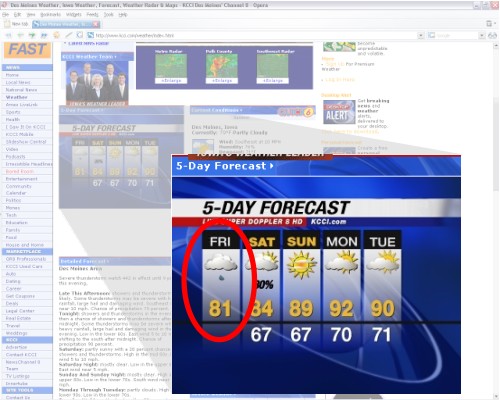 See the single raindrop? Here's the real story:       Kinda messy, with a few tornadoes around this evening and a lot of nasty wind and big rain. |
|
|
Ever have someone call you in the middle your busy day and then they launch into something completely unrelated to what you're doing? It's disorienting. It's sometimes abrasive. It can feel like someone busting the door down at your house while you're having dinner. On the flipside, do you ever do this to others? Most people will allow you to continue on once they've answered the phone because they don't want to be perceived as rude by dismissing you, but in fact, if you've completely interrupted them, they're only going to catch half of what you say, at best. Conversationally, how do you politely knock before you enter someone's world? How do you ready someone to hear you before you begin? It's really about expectation and permission. Most people don't need much time to switch gears. If you help them with this, you'll have a more successful conversation and both of you will listen better to the other. Start your part of the conversation with something that respects them and allows them an easy out. "Hi Sue. It's Brett. Is this a good time, or a bad time, to talk?" Or: "Hi Jason. This is Brett, and I wanted to know if you have a few minutes?" By starting with the question and suggesting that it's okay to delay the conversation, you honor their world. What's more, if now is a good time, they've given you permission to proceed, and mentally, they're more engaged, having set down their things, so to speak, to really hear you. The more you help others succeed at listening, the better your relationship will be. |
|
|
|
|
|
|
|

 The abdication of common sense is