a playground of art, photos, videos, writing, music, life
You are here
Creativity!
Get it!
I like it!
Fun stuff!
About me...
Random Quote
Mostly, we authors must repeat ourselves - that's the truth. We have two or three great moving experiences in our lives - experiences so great and moving that it doesn't seem at the time that anyone else has been so caught up and pounded and dazzled and astonished and beaten and broken and rescued and illuminated and rewarded and humbled in just that way ever before. -- F. Scott Fitzgerald
A businessowner hosted a roundtable on healthcare and small business, which President Bush attended. The result?
"He answered his own questions."
Which is pretty dumb.
"I thought the whole concept was to ask us, so I was a little bit frustrated. I would have liked the opportunity to give him my viewpoint, rather than him knowing the answer."
This entrepreneur, Clifton Broumand, happens to believe as I do on the subject of healthcare: that all children should be covered, and he gives a great reason.
"My personal feeling is that the plan should be to cover every child, whether it's private or federal," he said. "When you don't cover children, what ends up happening is that when kids are sick, which happens in my office, parents aren't productive. They have to go home."
Also like me, he doesn't see the government as an answer to this. He doesn't say why a government-run health system is not his choice, but for me, government is never an efficient answer for anything. And like Michael Moore, Mr. Broumand hates insurance companies.
The [insurance] plan he offers to his 28 employees costs $300 a month for individuals and $800 for family coverage. The business pays $5,600 a month for health insurance - more than it spends on rent - and premiums have increased 73 percent since 2003, he said.
Private insurers "are like the Godfather - they make you an offer you can't refuse," Broumand said. "When my insurance goes up 73 percent in four years, that's a tax... All these things are hidden taxes."
So what is the answer?
It might be in P2P insurance... which takes the profit motive out of the equation, while keeping the inefficiency out of it.
P2P will utterly change the face of the financial industry in the next 10 years. It will touch every financial product on the market. It will be interesting to watch as it unfolds...
I'll be creating an ongoing series called "My America." It will give what I think are the directions in which America ought to move, one of which will be covering healthcare costs for all children - but not for adults. I'll give my reasons later.
In the runup to the 2008 elections, I think it would be cool if bloggers would voice their ideas and opinions about the direction they think America should go. I believe that we the people are much smarter collectively than the politicians who greedily run this country for their own interests. So perhaps if bloggers jump in with a bunch of good ideas, one or more of those ideas will stick and bring solutions to life.
One of my favorite things to do in a mall is to bring a sketchpad and quickly pencil out the people I see in the food court. Typically, I only have a few brief moments. Some get self-conscious and discover what I'm doing (because I intermittently stare at them); some never notice. But it has to happen fast. It's a good exercise.
I'm an artist, so this is what I do.
You have talents... what do you do? Study their clothing? Their relationships? Their purchase decisions?
Malls are a wonderful study in human behavior. How do you make the most of the opportunity?
Not long ago, I was given the go-ahead to interview some amazing people. One of them, when I asked what he did for a living, told me that he liked to stretch people into uncomfortability along the direction that he thought they needed to go. Without his nudge, they probably wouldn't change.
Stretching is uncomfortable. People generally don't like doing it. But it makes us more limber, improves our strength, and is actually gentle.
A lot of us, to get in shape, rely on others to help and motivate us. A coach, a trainer, a friend, a video, a song...
We want others to encourage us.
Kathy Sierra's stagnant but brilliant blog, Creating Passionate Users, had a wonderful post about risk-aversion.
One of the benefits of having a scary illness or major loss is that it reminds you of just how much time is ticking away, and that you always have options to make changes. If you have a great idea, what do you risk by not persuing it? Will you have more regrets if you try and fail than if you don't try at all? Some of the best and biggest ideas happen within the scope of large companies, but some of the most world-changing happen... elsewhere.
Sometimes, outside influences force us to stretch. The world changes, and we respond. (I write this as I listen to Bonnie Raitt croon, "I Don't Want Anything to Change." Funny coincidence...)
Wayne Gretzky said so correctly, "You miss 100% of the shots you never take."
"But what if I miss?" is the whisper inside our heads, at times, when we want to stretch out in a new direction. "What if others see me fail?"
There's a danger in wanting others to encourage us. It beckons for approval. But here's the deal, which Kathy says in her post: "If you're not doing something that someone hates, it's probably mediocre."
Mediocre never changes the world.
So stretch... and stretch... and stretch. And stretch those around you. And never give up. The more at-bats you have, the more likely you are to hit a home run.
Annette recently wrote of persistence and a willingness to allow for temporary failure:
How many times would you let your baby try to walk? Of course the answer is, my baby is going keep trying to walk until he succeeds. No wonder you see so many people up walking around. Let's try this with ourselves. Keep trying until we succeed.
After Hurricanes Katrina and Rita disrupted the nation's energy lifeline two years ago, oil companies delayed maintenance on many of their plants to make up for lost supplies and take advantage of the high prices [emphasis mine].
Then oddly, the author throws in this next sentence:
But, analysts say, they are now paying a price for deferring repairs.
My question - what price are they paying? Because near the end of the article, we read this:
The refining business has never been so good for oil companies. Refining margins - the difference between the price of crude oil and the value of refined gasoline made from it - have shot up as much as $25 a barrel for some types of crude oil, compared with about $5 a barrel just a few years ago.
There's no price being paid here, except what we are paying at the pump. We're lining their pockets big time while they fiddle and enjoy big profits. That's irresponsible and I'm more pissed about it than before.
Could it be that housing values, 10 years from now, will deflate in the pursuit to find more affordable housing due to global competition? If we have to compete globally, and we do, then expenses must be trimmed, so it makes sense. Here's a scenario: what happens if the California housing market crashes? What if it happens elsewhere in America? How does that change the retirement plans of boomers at the time that they start retiring?
Affordability matters.
The first article says this:
A Florida recession could be averted and the state housing industry's "serious problems" solved by an influx of American retirees and foreign buyers, said David Denslow, a University of Florida economist in Gainesville.
"The wave of baby boomer retirees is gathering momentum, and the weaker dollar makes Florida seem like a bargain to Europeans," Denslow said. "With any luck at all that will sustain us."
Sometimes, we can have the most brilliant idea or the keenest insight. But if our audience isn't ready for it (maybe the wrong audience or the wrong time), it's a waste of time.
Waiting for fertile ground is key. Sometimes, in our excitement, we're more excited about the seed than the soil. Gotta have both. Pocket the seed until you know it can grow as you expect.
There are some things that I do very well, and others - well, not so much. One of my lesser skills, to put it nicely, is my ability to manage a To Do List.
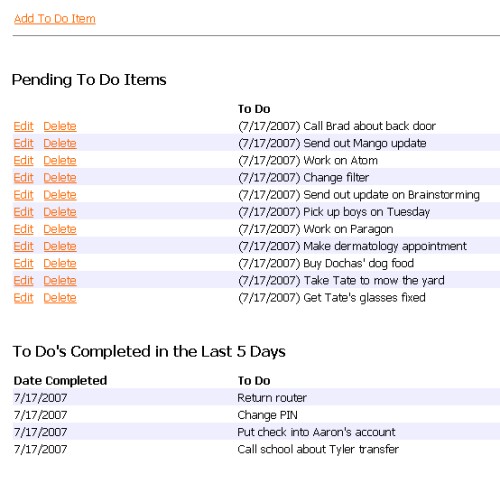
So last night, to get a better handle on it, I took an hour to create for myself a to do list manager. It's on a private part of this web site.
Pretty simple and sufficient for my needs. (Because it's on the web, Tamara and I can put things on the list and I won't forget them, as I sometimes do.)
I did a quick survey yesterday of the online tools out there for this kind of thing. All of them are free.
The top one is Ta-da List. It lets you create lots of to do lists. You can share your list with others, and in that way, it has a nice viral aspect to it.
Then there is Todoist, which offers more of a project to do list functionality. Pretty robust stuff.
And I found Remember the Milk, which is highly integrated with just about every online resource you know and use.
So with all of those free tools available, why in the world would I do it myself?
Doing it myself helps me to think it through and learn and discover. And ultimately, that has more value to me.