|
 |
RSS Feed  |
a playground of art, photos, videos, writing, music, life |
|
|

You are here
|

Creativity!
|

Get it!
|

I like it!
|

Fun stuff!
|

About me...
|
| |
|
|
|
|
Random Quote
My proof corrections consist of fights with proofreaders who know more about 'Webster's Unabridged' than about life.
-- William McFee
|
|
|
|
|
|
Page Through Blog: << More Recent Posts | Home Page | Earlier Posts >>
Blog Archive by Month | Blog Archive by Story or Tag | Search Blog and Comments
A Solution to Foreclosures |
Expanded thoughts on helping the economy, this time with Tamara's two cents as well... So that's our input. Here's a challenge, dear reader: What would you add/change to this to strengthen it and make it more likely to succeed? |
|
|
Amazing morning, here in West Des Moines. All of the trees are flowering...  And the greens are vibrant and rich...  These were taken in my front and back yard, respectively. |
|
|
Money the Old-Fashioned Way |
David Bach wrote a series of books on getting wealthy based on home-ownership. In the first half of this decade, his logic made sense: you can mortgage a new home, make the payments, and then watch your equity and personal wealth rise. In places like Orange County, California, the average home's value more than doubled between 2000 and 2005. Automatic Millionaire Homeowner? You betcha. It's how to make money without even trying, he coached. It used to be that a home was, well, just that: a home. Then people figured out that home values appreciate, and in the last decade, they appreciated faster than the rate of inflation. But when the value of the finished product rises faster than the cost to produce, that leads to oversupply because people see easy money, and oversupply means that a correction in assessed value is coming. David wasn't wrong. He preaches the long haul and learned his chops during a time when there wasn't a bubble in housing. Long-term, buying a house and living in it is a sound strategy for wealth. The thing is: this is the age of flipping the house, not investing in it. That depth of investment requires permanence and ours is a transient society. In? The home as the new ATM. Out? The home as a vehicle for retirement security. Now, I'm exaggerating - not everyone sees their home as temporary. But there was a commercial a couple of decades ago for the financial firm, Smith Barney, and the tag line was that Smith Barney made their money the old-fashioned way. "They earn it," stated the venerable John Houseman. "Old-fashioned." That phrase once had a romantic and sturdy air to it. Not any more. No financial institution today would try to impress upon us that their method of money management relies on "old-fashioned" practices. But here's something sobering: People in their 20s and 30s grew up in an age of unprecedented technological advancements - a factor that has affected their views of the future."This generation feels that somehow or another they're going to figure out some technological advancement that's going to get them out of their financial troubles and outsmart the market," says Manning, who served as adviser to the forthcoming documentary "In Debt We Trust." The documentary paints a picture of national financial crisis stemming from the personal-debt burden. [Generation Y] was kind of shielded from a lot of financial responsibilities. The generation's financial literacy is abysmal, with personal finances to match. Only 52% of high school seniors passed a recent national financial literacy test, meaning adults entering the work force do not know enough about basic budgeting, interest rates or taxes to make sound decisions for their own lives. According to the National Association of Realtors, today's median first-time homebuyer is 32 years old and puts down just 2% on a $150,000 home. Which means that today's median homebuyer only has $3,000 saved up. I almost wanna bet that some of that might have been borrowed from parents...From the article: The problem is not lack of smarts, but can be chalked up to an environment in which parents coddle their children, bank deregulation has made the financial landscape confusingly complicated, and consumerism rules. A nation of young adults coddled like Veruca Salt...I want the works
I want the whole works
Presents and prizes and sweets and surprises
Of all shapes and sizes
And now
Don't care how
I want it now
Don't care how
I want it now Waiting and saving for what you want? How quaint.A lot of parents believe that their job is to take care of their children, when in fact their job is to train their children to be self-sufficient adults. Vast difference. I'm not sure how to change our culture to once again cherish making money the old-fashioned way - earning it, saving it, investing it - but I suspect it might start by appealing to the retirement needs of parents who constantly have to jump in and save their kids. If the coddling ceases, the survival instinct will kick in. Does that sound mean? Keep in mind that I'm referring to 19-year-olds and not 9-year-olds. But then I think that should be obvious, shouldn't it? |
|
|
No big review here: just sayin' that we took the fam to see Iron Man yesterday. Everybody loved it. Robert Downey Jr was perfect in the role. 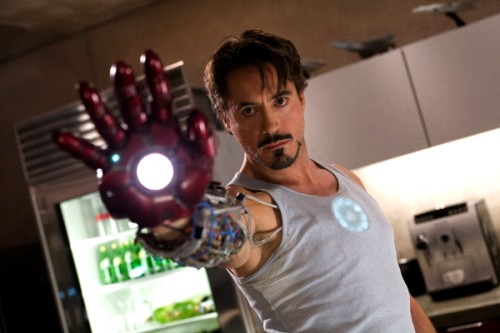 By the way - if you see it, stay for all of the credits. There's something you need to see at the end. What's interesting is that as we're walking away from the theater, I looked at Tamara and four of our sons. It occurred to me that the bunch with us was bigger than most families - and yet Aaron, Tate, Austin, and Jacob were only half our kids. (Bari saw it with us but had to leave for work right away, Nick was working at Blockbuster, Tyler was out skating, and Tess is in Georgia.) Good gravy, but our family is huge. ETC: Here's a bit of trivia - my web site alerts me that this is my 1000th post. |
|
|
I recently had a chance to help my son and my daughter work up a résumé. I could give you a bunch of career help clichés here, but you know them, so I won't. I did, however, want to hit on one theme that I don't hear too often: consistency. People do best when they learn something about you and they see or hear it portrayed to them over and over. "He's got such a great attitude.""Her insight is so on-the-mark." "She's always running circles around everyone else." There is a differentiator about you in your soft skills that separates you from others. It is your brand. And if there's one thing people like about the brands that they love, it's consistency in the ways that the brand distinguishes itself.This need for consistency doesn't mean that there can't be other means for variety. But if you're known for your insight, people expect you to continue to be insightful. If you're known for your energy, people expect you to be energetic. Any variation from that known and expected trait waters down your brand. I coached my kids to have the wording in their résumé reflect the testimonials from their references and what they would exhibit in an interview. Don't put "great customer service" on your résumé unless your references will say that about you. Talk about the strengths that your references will share with your potential employer. It will be in your résumé, in the words of those who have experience with you, and it will be obvious in how you carry yourself in every interview. Consistency in the brand of "you" sells you to the person looking for what you offer. In this niched world, if your brand is positive and you push hard enough, you'll find the right gig for your consistently demonstrated niche. ETC: It's tempting to apply this to other things, like political campaigns. Mitt Romney's slow traction for a lot of conservatives was the fact that he has espoused liberal positions in the past. His résumé didn't match his interview with the public. Same thing goes for Obama. The great "uniter" hung out for 20 years with an anti-American bigot. We become who we hang around, and people now question his brand's authenticity by his chosen associations. Consider how you want to be portrayed, and line up your résumé, references, and your interviews to reflect that portrayal consistently. |
|
|
My Suggestion for Solving the Recession |
The government wants to bail people out of their problems. It does this by taking your tax money and giving to people in crisis or to people who made poor choices. The Senate, for example, allotted $10 billion to refinance subprime loans. This would be unnecessary if people had the money to simply pay the mortgage to which they agreed. Using tax money only requires more taxes from the working anyway, and since we're bailing out the very people who pay taxes in the first place, it's kind of a dumb idea. But that's government for you. How do you get people to be willing to work harder / work more to pay what they owe? How about telling everyone who works a second job that the income they get from that job, for the time being, is tax free. You keep 100% of it. It's exempt. I think that would motivate the economy pretty well. It would stimulate job growth (more people productively working = more income = more people spending money = more jobs needed). It doesn't cost us anything from our current tax revenue. It's an efficient solution the government can offer. |
|
|
Okay... so here's a crazy thought. You're in marketing at McDonald's. What do you do to bring people to your store? Most people would focus on the food. New food products. Offer giveaways and discounts. Increase advertising. Ho hum. That's what everyone else might do, and it would typically increase expenses to achieve revenue and profits. You gotta spend money to make money. Yada yada. Or, you could focus on a different tack... what are people doing when they make the decision to visit a McDonald's? - Driving home from school activities.
- Driving to school activties.
- Driving to work.
- Driving home from work.
- Driving long distance - to see family or enjoy vacation.
See a theme?What do people do while driving? (Not just the driver, but the passengers too.) They listen to music. They snack. They talk on the cell phone. They play games. They watch movies- Stop right there. Parents love it when their kids watch movies while driving. The miles slip away more peacefully. Less fighting. Between the portable DVD player and the one that hangs from the ceiling in minivans, movies in the car are almost as indispensible as the cup holder. Hmm... what if McDonald's offered movies? Interesting idea, but as people drive around town, they rarely go back to the same McDonald's every time. Okay - so make it that you can return the movies to any McDonald's. Hmm... and what if it was only a dollar to rent? So imagine this scenario: you're driving across the country in your family minivan. The kids are tired of the three movies you brought with you and they're starting to pick at each other out of boredom. You have a choice between Burger King, Wendy's, and McDonald's at the next exit. Which do you choose? Why, the one that makes the trip easier, of course. Perhaps, the one with kiosked movies. What a beautiful concept. McDonald's new advertising just became a profit center. Redbox movies, per kiosk, averaged almost $40,000 in 2007. Don't just think of how to make your product more attractive. Think of why people come to your business and think of what they're doing at the time that they think of your business. Giveaways and promotions and advertising and discounts all cut into your profits. Is there a different way? Can you enhance your business through a symbiotic partnership? Think through the scenarios that bring people to your store and look for ways of greasing that wheel. |
|
|
Re: the FLDS sect in Texas and the state's confiscation of over 400 children. What do you get when you cross arranged marriage and polygamy and pedophilia and religion and incest? Some people are upset that the state used what appears to be a bogus phone tip about the abuse of a 14-year-old girl to remove not just girls from the custody of their parents, but boys as well. The abuse of big government, they cry! I'm no advocate of big government, as anyone who knows me or reads my web site will say. But... show me the 14-year-old girl in any society who is mature and confident enough in her decision to consensually marry a middle-aged man. I don't care what your culture is, some things are obviously wrong and don't require debate. Allowing a deviant nutjob to create his own society where he can harvest 80 wives, some of whom were 14 years old, would be one of them. Does the state of Texas have the authority to go in clean up the mess created by a ring of pedophiles? Frankly, I wouldn't care if armed Boy Scouts in Eldorado, Texas, went in and broke up this illicit farce - it needed to be broken up. Some assert that the kids need to be returned to their parents, as Dr. Phil did at the end of his show on the subject. I get his point. But the families, after several generations of this lifestyle, will only try to continue as they have in the past. While it is traumatic for people to have to relearn what they have believed all of their lives, not every myth carries with it a Santa-like innocence. So to answer my earlier question: What do you get when you cross arranged marriage and polygamy and pedophilia and religion and incest? A lot of ruined lives. To put the chlidren back in this "lifestyle" with people who will try to continue to live this way is no answer at all. |
|
|
 Tamara and I watch American Idol, and far and away, the one to beat, despite Simon's assertions otherwise, is David Cook. It's not because David is the best vocalist - he's not. It's because he knows what he does best and he chooses songs that can be performed his way and he rarely does the song like the original. He niches himself very, very well. I'd eagerly listen to his music because it's unique and well done. He surprises me, and I look forward to the surprise he brings. In fact, if it wasn't for him, I'm not sure that I'd want to watch the show. Tamara and I watch American Idol, and far and away, the one to beat, despite Simon's assertions otherwise, is David Cook. It's not because David is the best vocalist - he's not. It's because he knows what he does best and he chooses songs that can be performed his way and he rarely does the song like the original. He niches himself very, very well. I'd eagerly listen to his music because it's unique and well done. He surprises me, and I look forward to the surprise he brings. In fact, if it wasn't for him, I'm not sure that I'd want to watch the show.
The "one to beat," as Simon puts it, is David Archuletta, who is an exceptional vocalist, but with the exception of his version of Imagine earlier in the season, I'd never run to the store to get anything he does. As they say about Enya, you can start anywhere with any song and it sounds exactly like the same song every time. There's no surprise. He delivers a few nice runs in any song that will sound pretty much like the original version, but nothing else. The person I want to do well is Carly. Tamara too... we both like her and want her to do well. The problem? She never makes it her own. She picks songs she can sing well - and sing well she can. But like Syesha and little David, it sounds like the original. Which is disappointing. She has more passion than all of the others combined, and that's what is carrying her through right now. Which says a lot about passion... Jason Castro? Initially, I didn't really like him, but as he gains confidence in knowing what it is that he does well and executes that - kind of a lighter version of David Cook's originality - he's growing on me. It's how he makes the songs his own that pulls him through. You don't have to be the best at what you do technically. But you do have to know what you do well and do it in a unique way - a way that makes it memorable. If it looks like everyone else, you're wallpaper. How can you be pleasantly surprising? Catchy? Infectious? How can you make people eagerly anticipate what you the niche of what you do? It starts with the willingness to take a risk. The safe way is doing things like everyone else did them successfully. Best practice, they call it. That's crap. It's just one way of doing it. I read something yesterday while preparing for a meeting. "What is an employee's purpose? Most would say, 'To help the company achieve its purpose.' But they would be wrong. That is certainly part of the employee's role, but an employee's primary purpose is to become the-best-version-of-himself or -herself." That's pretty provocative. In fact, it caught me by surprise. Think that over... because I think that statement is breathtakingly spot on. |
|
|
|
|
|
|
|